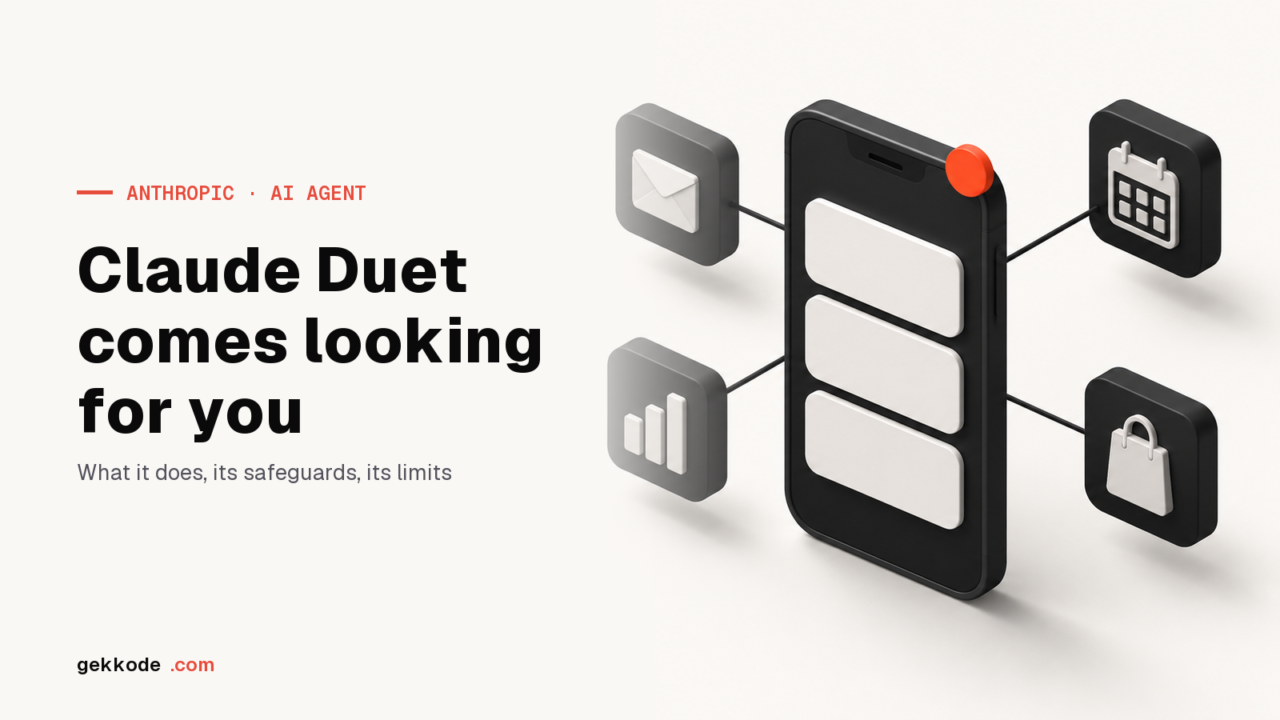
Claude Duet is an Anthropic app, opened on 21 October 2026, where Claude works as a proactive agent. It watches the apps you connect, sends you a brief every morning, carries out tasks and alerts you when a decision is yours to make, asking for your approval before it sends, pays, signs or deletes anything. For now, it is limited to Pro and Max subscribers in the United States, through a waitlist.

Claude Duet : l'agent IA d'Anthropic qui vient te chercher
The Gekkode YouTube channel publishes more videos about AI and code.
Subscribe to support the channelUntil now, you have been the one who starts the conversation with an AI. On 21 October 2026, Anthropic opened Claude Duet, an app where Claude comes to you on its own when something needs you, and keeps working after you put your phone down.
Claude Duet reads your email, your calendar and your work tools, prepares whole tasks and asks for your approval before it sends, pays for or signs anything. For now, it is a research preview limited to Pro and Max subscribers in the United States, through a waitlist.
An app where Claude takes the initiative
Claude Duet is a separate app, on iPhone and Android, and also on the claude.ai website. Anthropic’s announcement of 21 October 2026 presents it as an app where Claude works as a proactive agent. An agent is an AI that acts in your apps on your behalf, instead of only answering your questions.
Proactive means it takes the initiative. A chatbot waits for your question. A proactive agent watches your apps, sorts what comes in and comes to find you when a decision is yours to make, like an assistant who pops their head round your office door.
Anthropic says it built it for professionals and small business owners who have more on their plate than they can keep track of. During the preview, it is included in the Pro and Max plans at no extra cost.
The morning brief, then silence
You start by connecting your apps: your email, your calendar, your accounting software or your Slack. Every morning after that, Claude Duet sends you a short brief with the few important topics of the day. Anthropic’s help page in French explains that it goes through your emails and calendar at that point, and can start on the first steps, such as drafting replies for you to review.
The rest of the time, it stays quiet until something really needs you. The launch film, a demonstration staged by Anthropic, gives an example. A shop is due to open in Chicago in twenty-six days, the health permit has not been filed, and Claude Duet has already prepared the application. All that is left is to read it over and pay.
Real tasks, on its own computer
Claude Duet does more than send alerts. You can hand it tasks of any size: scheduling a meeting, building a sales dashboard, putting together a financial forecast, even building a small web app. The help page gives sample requests, such as “Check Stripe for unpaid invoices and draft reminder emails for me to approve”.
To do its work, it has its own computer in the cloud, with its own web browser. This is a virtual machine, a computer that exists only on remote servers, a bit like a rented office you would never visit. Your computer and your phone therefore do not need to be switched on. When a website has no connector, Claude Duet opens it in that browser, just as you would. Larger jobs come back as files to review: a dashboard, a financial model or a slide deck.
What it already knows about you
Claude Duet runs on your Claude account. It picks up what Claude already knows about you: its memory, your skills, those instruction sheets that teach it a way of working, described in our guide to SKILL.md files, and your connectors. A connector is a plug that links Claude to an app, Gmail or Google Calendar for example, so that it can read and act there.
Anthropic announces more than 6,000 connectors and plugins in its store, the Claude Marketplace, from Gmail to Stripe by way of Shopify and Docusign. You start each connection yourself, and you can cut any of them off at any time. Claude Duet runs on Claude Opus 5.5, which we compared with Sonnet 5.5 in our test on the same 3D scene, and you cannot pick another model.
Nothing goes out without your approval
An AI that reads your emails and can pay on your behalf has to know where to stop. Before it sends a message, pays, signs a document or deletes anything, Claude Duet shows you exactly what it is about to do and waits for your go-ahead. If you are not available, it finishes the rest of the task and brings the request back to you later.
Some actions are off limits even if you say yes. It cannot buy or sell on the stock market, move money from one account to another, or access someone else’s account. For purchases, it goes through Link, Stripe’s payment wallet, or Shop Pay, Shopify’s. Each purchase uses a single-use virtual card, valid for that one purchase only, and your real card number is never shared.
The risk of booby-trapped emails
Every action Claude Duet takes goes through the same check as Claude Code’s auto mode, a program that examines the action before letting it through. Even so, Anthropic admits that no defence is perfect. Claude Duet reads text written by other people, emails and web pages, and an email can hide instructions written to fool the AI, like a fake note from the boss slipped into a pile of post. This is called prompt injection.
It is one of the reasons why important actions wait for your approval. This risk, and what helps contain it, are covered in detail in our test of the Claude Code and Codex sandboxes.
The limits Anthropic acknowledges
Anthropic is fairly frank about what does not work yet. Claude Duet can misread a conversation thread or get wrong what is urgent, hence the advice to read drafts over before approving them. It only checks your accounts at regular intervals, every few hours according to the announcement, so an urgent message can arrive between two checks.
It is not free behind the scenes either. Claude Duet draws on the same usage quota as your Claude subscription, and its background work counts too, from the morning brief to the checks and the big tasks. You may hit your limits sooner than if you only chat with Claude.
What about France?
Anthropic has not announced a date. During the research preview, you need a Pro or Max subscription, a Claude account in the United States and an invitation from the waitlist. Invitations go out in waves, and the Team and Enterprise plans, aimed at businesses, will follow later according to Anthropic.
The help page describes how to sign up. On the Claude Duet product page, you choose “Join the waitlist”, then give your name, the email address of your Claude account, your plan and your type of phone. Access stays tied to that address.
The fourth personal agent in ten weeks
Anthropic is not alone in this field. xAI launched Grok Bot in beta on 11 August 2026, according to The Tech Outlook. Meta unveiled Muse, its personal agent, on 8 September. OpenAI revealed Dots, always-on agents in ChatGPT, at its DevDay conference on 29 September, TechCrunch reports. Claude Duet is the last of the four to arrive.
| Agent | Company | Launch |
|---|---|---|
| Grok Bot | xAI | 11 August 2026, in beta |
| Muse | Meta | 8 September 2026 |
| Dots | OpenAI | 29 September 2026 |
| Claude Duet | Anthropic | 21 October 2026, preview in the United States |
In principle, all four are alike, with an agent that works without you and comes back when a decision is needed. Anthropic is mainly targeting professionals and small businesses, and is betting on caution, with an approval step for every action that commits money, a message or a signature.
What Claude Duet changes
With Claude Duet, AI goes from a tool you open to a colleague who chases you up. To warn you in time, it has to read your mail, your calendar and your work tools continuously. Before you join the waitlist, you still have to decide whether you are ready to hand it your inbox.
Key takeaways
- Claude Duet, opened on 21 October 2026, is an Anthropic app where Claude acts as a proactive agent. It watches your connected apps and comes to find you when a decision is yours to make.
- It sends a brief every morning and carries out complete tasks, from booking a meeting to building a dashboard, on its own computer in the cloud.
- It asks for your approval before it sends, pays, signs or deletes, and stock market trades and transfers between accounts are off limits.
- It can make mistakes, only checks your accounts every few hours and uses up your subscription’s quota.
- It is limited to Pro and Max subscribers in the United States, through a waitlist, with no date announced for France.