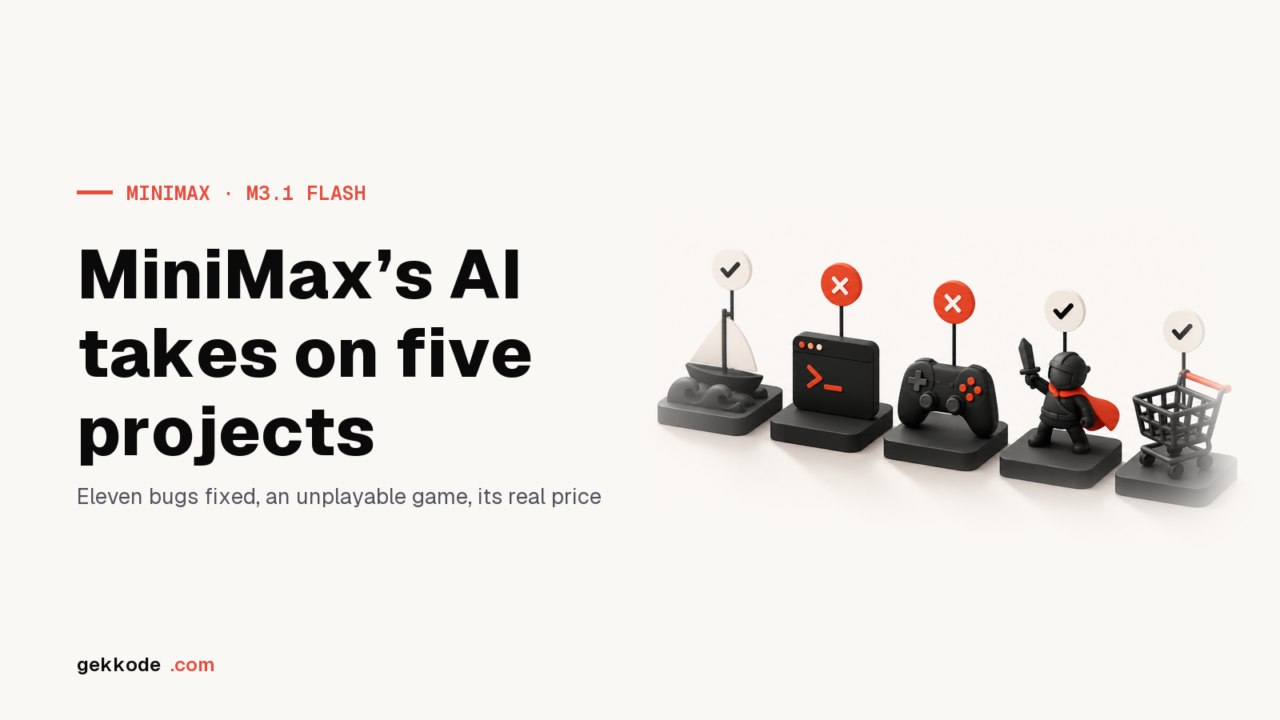
MiniMax M3.1 Flash is MiniMax's fast, low-cost AI model, released on 19 October 2026 and free for a limited time in OpenCode, with no account needed. In our five challenges, it fixed all eleven bugs in a real PrestaShop shop, but delivered a tactics game you cannot play with the mouse and a fake Linux broken by its last fix. At the official rate, the five tests would have cost about $4.40.
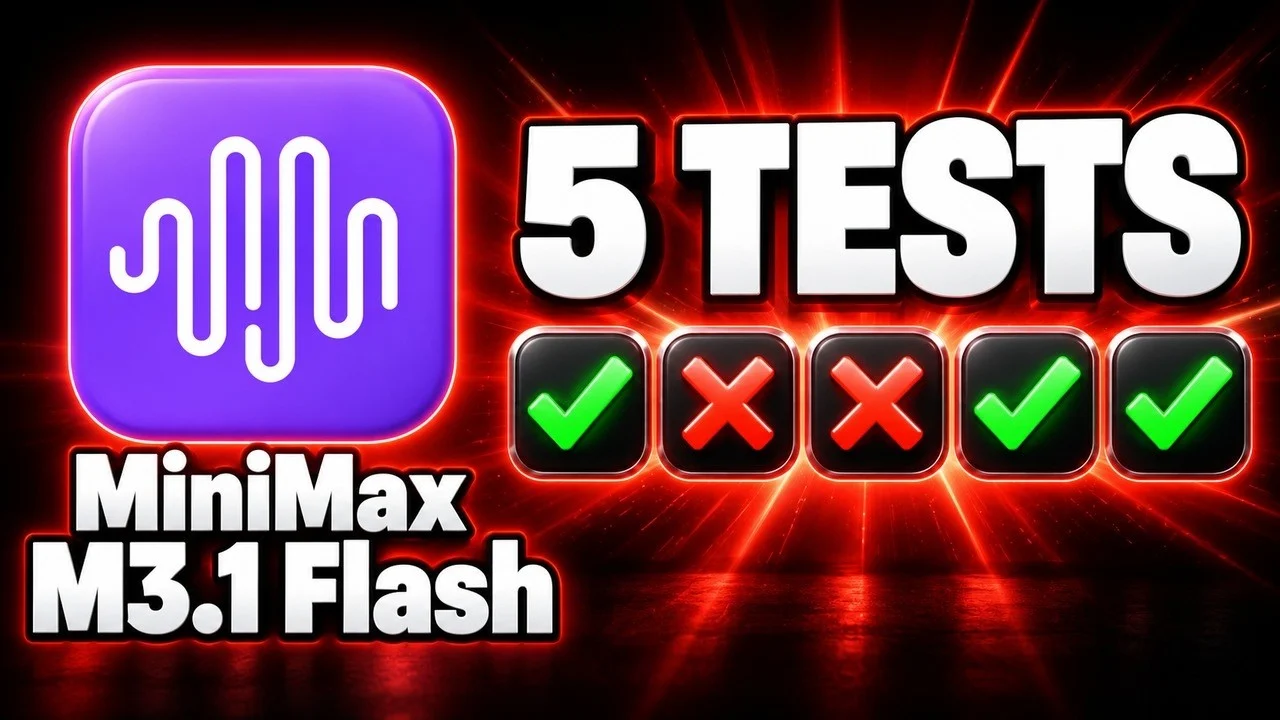
MiniMax M3.1 Flash testé : j'ai caché 11 bugs, il les a tous corrigés
The Gekkode YouTube channel publishes more videos about AI and code.
Subscribe to support the channelOn 19 October 2026, MiniMax released M3.1 Flash, an AI model that can code, and OpenCode made it available for free for a limited time, with no account and no key. We put it through five filmed challenges, from a 3D sailing boat to a real online shop booby-trapped with bugs.
The verdict fits in two sentences. When it comes to repairing an existing project, M3.1 Flash fixed all eleven bugs in a PrestaShop shop in forty minutes, with no internet access. When it comes to building from scratch, it works fast, but you have to double-check its work.
MiniMax, the company behind Hailuo
MiniMax is an artificial intelligence company based in Shanghai, founded in late 2021. In France, it is best known for Hailuo, its video generator. M3.1 Flash is the fast, low-cost version of its new language model.
In its announcement of 19 October 2026, MiniMax promises a model nearly three times faster, and agent tasks 70% cheaper than with its previous model. An agent is an AI that carries out a series of actions on its own, such as reading files, editing them and running commands. M3.1 Flash can also keep a million tokens in mind, enough to read several novels in one go. A token is a piece of a word, the unit that models read and bill for.
In OpenCode, with no account and no key
OpenCode is an open source coding assistant: it reads your project, writes the files and runs the commands for you. For a limited time, M3.1 Flash is on its list of free models. You just pick it, with no account to create and no key to enter.
OpenCode’s documentation states that the provider of this model does not keep your data and does not use it to train its models. That was not the case with Big Pickle, the previous free model, whose data could be used to improve it. The same page warns that M3.1 Flash is free for a limited time, with no end date.
Five challenges, always at the maximum setting
Each challenge ran in a sandbox, a Docker container isolated from the rest of the computer, like a locked room where the AI cannot break anything else. Reasoning was set to the maximum, the briefs were pasted in unchanged, and nobody helped it along the way. Every exchange with the model was counted.
The sailing boat in the storm
The first brief is the one from our previous benchmarks: a fishing boat under sail on a rough sea, in the middle of a storm, in 3D in the browser. M3.1 Flash ticked off all thirteen points of the brief in 72 minutes. Claude Opus 5.5 had taken 39 minutes, for about seven dollars on pay-as-you-go billing. Here, the bill came to zero, and both scenes run just as fast on the same Mac.
Linux in the browser: 41 out of 42, then 24
Second challenge, the Big Pickle rematch: a complete fake Linux in the browser, with a desktop, windows, a terminal and an editor. After each stage, a robot clicks everywhere and checks 42 points. Big Pickle had finished on 41 out of 42.
After the nine build stages, M3.1 Flash is on 40. The tenth brief hands it the list of failures and asks it to fix them, in three rounds at most. In the first round, it moves up to 41, Big Pickle’s score, in an hour and a half instead of two. That leaves just one point, window resizing.
In the second round, it fixes that, and the score drops to 24. At the smallest window size it chose, the folder path grows longer and squashes the area where you type, which ends up zero pixels wide. As it happens, the robot leaves the window at exactly that size, and every check that goes through the terminal fails. Even with the list of eighteen failures in front of it, it cannot find the cause. At normal size, its fake Linux works very well.
A Final Fantasy Tactics clone: complete, but unplayable
The third challenge asks for a playable clone of Final Fantasy Tactics, the 1997 strategy game on PlayStation, with its multi-level terrain, its turns, its menus and its rules. Two hours and forty-eight minutes later, the battlefield is there, with its cliffs, its water and blue menus reminiscent of the original.
For a prototype made by an AI, the engine is fairly complete compared with the original game. Each unit takes its turn according to its speed, a hit in the back does more damage, and spells take time to cast: if the target moves, the spell misses. The interface for moving around, however, could have been far better designed.
The real problem shows up in the first battle. Clicking “Move” does nothing, though the keyboard works. In the “Action” menu, clicking “Attack” does nothing either, and neither do the Enter and Esc keys. The menu redraws itself as soon as the mouse passes over it, which swallows the click, and the code provides no key to confirm this submenu. A player simply cannot attack. Yet MiniMax’s own tests passed: they pressed the buttons directly in the code, never with a real mouse. Eleven of the brief’s eighteen points are met, four only halfway, and the two that fail outright are precisely the ones that make it a game.
ODD ARMS: the most polished, flaws and all
Fourth challenge, the longest brief, more than twelve thousand characters: ODD ARMS, a survival game where a little hero armed with absurd objects holds out for three minutes against hordes of toys. Two hours and nineteen minutes later, the game runs, with ten heroes, twelve weapons, a 3D preview and real, playable rounds.
The brief’s numerical rules are respected, from a ring of fifteen enemies closing in every 22 seconds to the limit of 180 monsters on screen. Importing a custom 3D model rejects a fake file and a file that is too large, and accepts the right one. On a phone, the joystick and the dash button work at the same time. But the 3D models are ugly and strange, and the hero can leave the map by walking through the walls of the arena. MiniMax stopped there, without going any further.
The booby-trapped shop: 11 bugs out of 11
Last challenge, the closest to real work: a shop running PrestaShop, e-commerce software made up of nearly forty thousand files. We slipped ten bugs into it, and kept an eleventh, a real one, reported on GitHub in July and still present in this version. M3.1 Flash received eleven tickets written the way a customer would write them, and the shop was cut off from the internet.
After forty minutes, it reports all eleven tickets fixed. Our nineteen hidden checks, one per bug and eight to make sure it had not broken anything elsewhere, all pass. It touched exactly the ten right files. A price displayed as “34,8 €” goes back to “34,80 €”, the pagination gets its third page back, and a customer can no longer open someone else’s order.
Two caveats. Seven of its fixes are identical, down to the letter, to the original code. PrestaShop is public, and M3.1 Flash may have learnt this code during its training. The real GitHub bug, for its part, gets fixed in its own way, whereas the official patch also covers a rare case on older databases.
Where it falls short
The free gateway is not reliable. Across the five challenges, it failed 72 times out of about 1,300 exchanges. OpenCode retries on its own, but on one occasion, two and a half minutes of reasoning went in the bin.
On big projects, M3.1 Flash spends as much time testing itself as thinking, and even more so on the Linux test. Above all, it tests itself badly. Its fake Linux passed all of its own tests while breaking text input, and its game passed its own without ever touching the mouse. If you use it, check for yourself with a real mouse and a real keyboard, and treat its “it’s done, it’s tested” as a draft. To keep an agent like this one contained, you are also better off with a real sandbox than with a simple list of banned commands.
What MiniMax M3.1 Flash costs
Outside OpenCode, the official API pricing is $0.15 per million tokens read, $0.60 per million tokens written, and $0.015 for tokens read back from the cache, meaning tokens already sent and kept in memory. At that rate, our five challenges would have cost about $4.40 in total, from $0.28 for the sailing boat to $1.35 for the Linux test. Almost everything went through the cache, billed at a tenth of the price.
For coding every day, MiniMax also sells a subscription, the M Plan, which takes over from the former Coding Plan. It costs $22 a month on the Go tier, $55 on Explore and $132 on Build, with M3.1 Flash included in all three. The subscription key plugs into OpenCode, Claude Code or Cursor.
Key takeaways
- MiniMax M3.1 Flash, released on 19 October 2026, is free for a limited time in OpenCode, with no account or key, and its provider does not keep your data.
- For repairing an existing project, it is impressive: eleven bugs out of eleven in a real PrestaShop shop, in forty minutes, with no internet access.
- For building from scratch, it works fast, but its own tests do not see what a player sees: a tactics game you cannot play with the mouse, and a fake Linux broken by its last fix.
- Always check its work yourself with a real mouse and a real keyboard.
- At the official rate, our five challenges would have cost about $4.40, and the M Plan subscription starts at $22 a month.