On the same 3D brief, a fishing boat in a night storm, GPT-6 Luna worked for 2 minutes 42 seconds for about $0.012 at API rates, Claude Haiku 5.5 for 8 minutes 49 seconds for about $0.18, even though both have the same price per token. Both pages work, but Haiku 5.5's scene is far richer, while Luna's remains a very dark sketch.
Anthropic released Claude Haiku 5.5 on 7 October 2026, two weeks after OpenAI’s GPT-6 Luna. These are the smallest and cheapest models on each side, sold at exactly the same price per token. The day after Haiku 5.5 came out, I gave them the same brief as their bigger siblings, a night storm in 3D, to see what each one does with a small budget.
Haiku 5.5 worked in Claude Code, Anthropic’s coding assistant, and GPT-6 Luna in Codex, OpenAI’s. Both wrote a file on the computer without ever seeing it displayed. The bench below runs both scenes on your own machine, with nothing to install, and the full-screen view puts them side by side.
La consigne de nos trois premiers duels, un voilier de pêche dans une tempête de nuit en 3D, cette fois pour les deux plus petits modèles du moment : Claude Haiku 5.5 d'Anthropic et GPT-6 Luna d'OpenAI. Les deux scènes s'exécutent telles qu'elles ont été livrées, sans aucune retouche.
Shared prompt
Crée une scène 3D en three.js, dans un seul fichier index.html autonome, sans build ni dépendance locale (three.js chargé depuis un CDN par import map en module ES, version r170 ou plus récente).

Sujet : un voilier de pêche navigue de nuit sur une mer agitée, en pleine tempête.
- Mer : surface animée avec des vagues (déplacement de vertex), reflets sombres, écume discrète sur les crêtes si possible.
- Ciel : nuit noire, nuages bas, pluie visible (particules) poussée par le vent.
- Éclairs : toutes les quelques secondes, un éclair illumine brièvement toute la scène (flash, fort contraste, silhouette des nuages), avec un délai aléatoire entre deux éclairs.
- Bateau : coque, pont, mât, gréement et voile, modélisés uniquement avec des primitives three.js (aucun modèle externe, aucune texture externe). Il tangue et roule en suivant les vagues.
- Lanternes : au moins trois lanternes accrochées au bateau, lumière chaude et vacillante, qui éclairent le pont et l'eau autour du bateau.
- Caméra : contrôles orbitaux (OrbitControls) avec une position de départ qui met le bateau en valeur.
- Performance : viser 60 images par seconde sur un ordinateur portable ; le redimensionnement de la fenêtre est géré.
- Interface : aucune, à part un petit texte discret en bas à gauche indiquant les commandes.

Contraintes : tout le code (HTML, CSS, JavaScript) dans index.html ; pas de fichiers supplémentaires ; le fichier doit fonctionner en l'ouvrant directement dans un navigateur moderne (Chrome, Firefox, Safari). Ne pose pas de question, livre le fichier complet.
Protocol
La même consigne, en français, que lors des duels du 7, du 22 et du 29 septembre 2026, envoyée telle quelle, sans échange ensuite. Claude Haiku 5.5 a travaillé dans Claude Code et GPT-6 Luna dans Codex, le 8 octobre 2026, tous deux réglés sur le niveau de réflexion « xhigh », avec les réglages d'origine et une sandbox : écrire dans un dossier vide, sans sortir de ce dossier ni ouvrir de navigateur. Un seul essai chacun, lancés au même moment sur la même machine. Aucun des deux n'a vu sa scène avant de la rendre. Mesures : temps de travail, coût au tarif public de l'API, respect point par point de la consigne, erreurs au chargement, rendu dans Chrome en 1 280 × 720, fluidité sans carte graphique puis sur une carte graphique récente, sans limite d'images par seconde, les deux scènes mesurées le même jour sur la même machine.
Runs in an isolated sandbox (iframe sandbox and CSP): no access to the site, cookies or your session. Nothing loads before you click.
Runs in an isolated sandbox (iframe sandbox and CSP): no access to the site, cookies or your session. Nothing loads before you click.
| Measurements | A · Codex · GPT-6 Luna | B · Claude Code · Claude Haiku 5.5 |
|---|---|---|
| Temps de travail | 2 min 42 s | 8 min 49 s |
| Coût au tarif public de l'API | ≈ 0,012 $ | ≈ 0,18 $ |
| Fichier livré | fonctionne | fonctionne |
| Points de la consigne respectés | 13 sur 13 | 13 sur 13 |
| Erreurs au chargement | 0 | 0 |
| Poids de la page | 21 Ko | 24 Ko |
| Bateau | voilier à un mât, grand-voile claire et cabine | bateau de pêche à un mât, timonerie et bastingage |
| Lanternes | 3 | 4 |
| Gouttes de pluie | 850 | 7 000 |
| Images par seconde sans carte graphique (rendu logiciel, sans limite) | 20 | 31 |
| Images par seconde sur carte graphique récente (Apple M5 Pro, sans limite) | 213 | 730 |
Verdict
GPT-6 Luna rend une scène qui fonctionne en moins de trois minutes pour environ un centime. Claude Haiku 5.5 met trois fois plus de temps et coûte une quinzaine de fois plus, pour une tempête bien plus riche : un vrai bateau de pêche, une mer qui se soulève, une pluie dense et des éclairs qui illuminent tout. Luna livre une esquisse très sombre mais sans faute, Haiku une scène presque aussi soignée que celles des grands modèles.
Two small models at the same price
On the 7 October launch page, Anthropic presents Haiku 5.5 as its model for large volumes of cheap tasks: summarising, sorting, querying a database, or backing up Sonnet 5.5 and Opus 5.5 on coding work. It is the first Haiku whose level of reasoning can be adjusted. GPT-6 Luna, released on 22 September alongside GPT-6 Sol, plays the same role at OpenAI: LLM Gateway’s changelog describes it as Sol’s little brother, with prices twenty times lower.
The price list gives both the same line: 0.10 dollars per million tokens read and 0.50 dollars per million written. A token is a piece of a word, the unit these models read and write in. For Haiku 5.5, Anthropic’s pricing page specifies that this price applies to requests of fewer than 100,000 tokens, and that Sonnet 5.5 costs twenty times more.
Anthropic also publishes a head-to-head between the two. On Terminal-Bench 4.0, a test where the AI has to complete tasks in a terminal, Haiku 5.5 scores 39.2% against 16.4% for Luna. On FrontierCode 1.1, a more open-ended programming test, the gap narrows: 46.4% against 42.4%. These figures come from Anthropic, which has every interest in placing well. Our storm is there to check what they amount to on real work.
Same brief, same setting, same day
The request is the one from our face-off between Opus 5.5 and Sonnet 5.5, itself taken word for word from the face-off between Opus 5.5 and GPT-6 Sol. Everything has to fit in a single HTML file built on three.js, the free toolbox for 3D on the web. The brief lists thirteen points: waves with foam on the crests, a low, moonless storm sky, rain slanted by the wind, lightning at random intervals, a boat built from simple shapes that pitches with the waves, at least three flickering lanterns, a camera you steer with the mouse and a short help text.
Both models received this brief on 8 October, twenty-six seconds apart, with a single attempt, no touch-ups and the “xhigh” reasoning level, one notch below the maximum, which sets how long the model gives itself to draft before handing in its paper. Each worked inside a sandbox, a sandpit that confines the AI to its working folder and to web searches (our guide to the Claude Code and Codex sandboxes explains how it works). That sandbox also blocks the browser, so neither Haiku 5.5 nor Luna saw their storm before handing it in.
Luna delivers in under three minutes, Haiku in nearly nine
GPT-6 Luna delivered its file after 2 minutes and 42 seconds. It looked at the folder, wrote the whole page in one go, then touched up the lightning bolt’s path so that it stays a single stroke on screen. Claude Haiku 5.5 took 8 minutes and 49 seconds: four minutes of thinking before its first action, an attempt to download three.js to test its code, refused by the sandbox, then the entire page written in one go around the eighth minute, and a syntax check of its code.
The bill follows. Charged like a developer who calls the model directly from their own software, Luna’s work comes to about 0.012 dollars, a little over one cent. Haiku 5.5’s costs about 0.18 dollars, fifteen times more, even though the two models have the same rate. The gap comes from the amount of text written: Haiku 5.5 produced nearly eight times more words than Luna, almost nine tenths of them in its thinking draft. For comparison, Opus 5.5 had cost 6.96 dollars for the same brief. Both runs were paid for by a subscription, which deducts them from a usage allowance instead of billing them.
The result: a dark sketch against a real storm
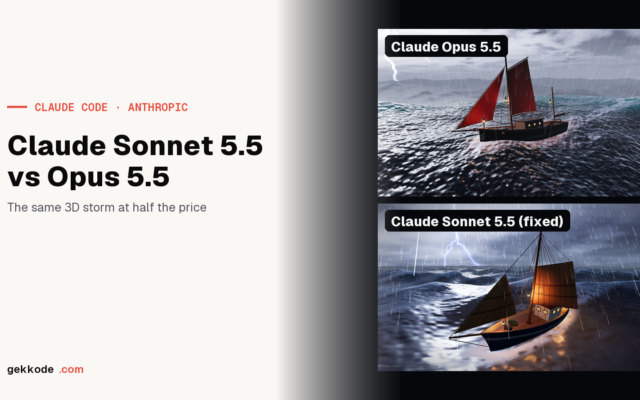
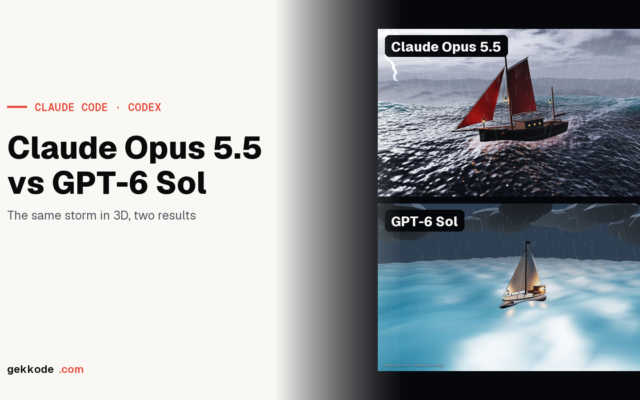
Both files open without a single error and meet all thirteen points of the brief. They weigh 21 and 24 kilobytes, against 43 for Opus 5.5 and 54 for Sonnet 5.5. The resemblance ends there.
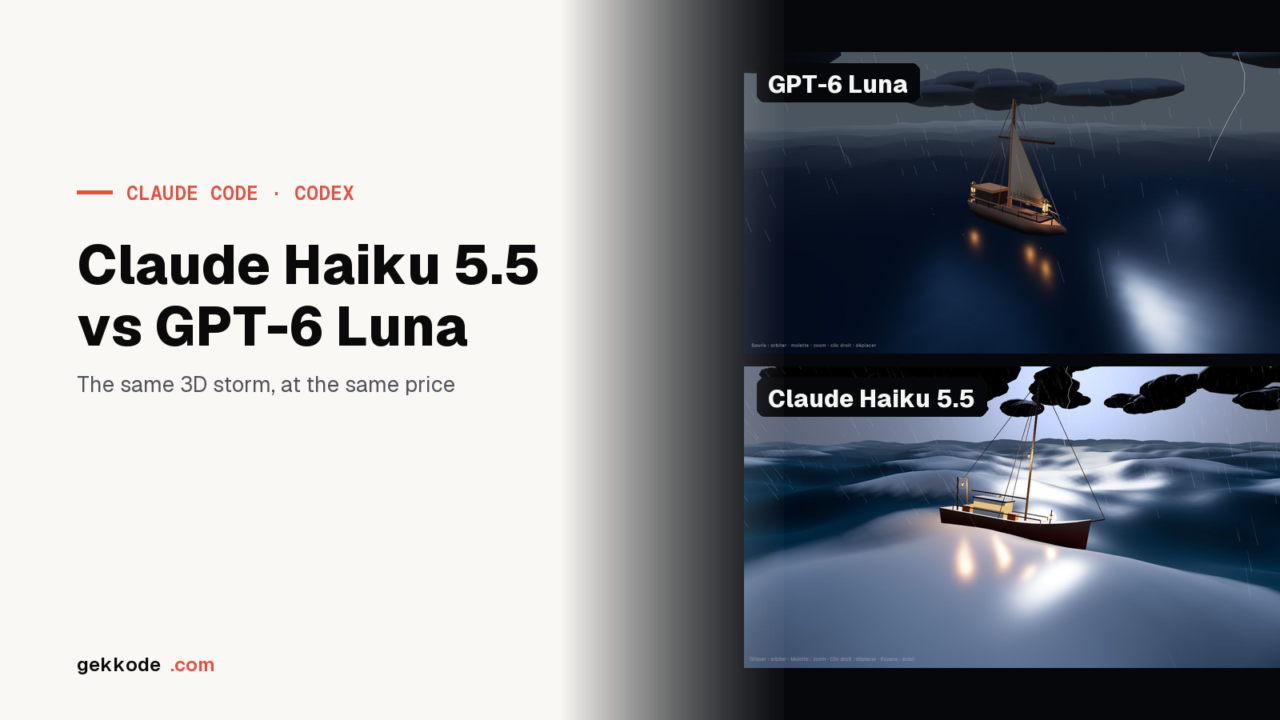
Luna built a single-masted sailboat, with a large pale sail, a small cabin and three lanterns that flicker and reflect in the water. The night is very dark. Between two flashes, you can barely make out the boat and the sea. When the lightning strikes, a white zigzag crosses the sky and the scene turns blue-grey, but the sea stays barely rippled and the rain, only 850 drops, leaves large gaps.
Haiku 5.5 drew a single-masted fishing boat, with a wheelhouse with lit windows, a railing, shrouds stretched down to the deck and four lanterns spread around the boat, swinging with the roll. The swell lifts and tilts the boat, with foam on the crests. The rain has 7,000 drops that the wind pushes sideways. The black clouds stand out in silhouette, and each flash of lightning, spaced from two and a half to seven seconds apart, lights up the sky and turns the whole sea silver. Haiku 5.5 even added, unprompted, a Space key to trigger lightning at will.
Haiku 5.5 did not see its scene either. It said so in its last message, pointing to a fragile spot in the way it drew the sea, which it had not been able to test. That spot worked.
Hundreds of frames per second on a graphics card
Both scenes were measured on the same day, on the same machine. On a recent graphics card, that of a Mac with an M5 Pro chip, Luna shows 213 frames per second and Haiku 5.5 730, measured with no cap. The brief asked for 60, and both clear it by a wide margin.
On a computer without a graphics card, where the processor draws everything on its own, Luna’s scene runs at around 20 frames per second and Haiku 5.5’s at around 31, the median of four runs. Neither reaches 60 under these conditions, but the richer of the two is also the smoother.
Luna or Haiku: which one to pick?
- For a quick, almost free answer, no frills, GPT-6 Luna. Its scene works first time in under three minutes and for about one cent. It gives you a good base to touch up, not a result to show off.
- For a result worth showing, on a small budget, Claude Haiku 5.5. For eighteen cents, it delivers a scene almost as polished as those of Sonnet 5.5 and Opus 5.5, which cost twenty to forty times more.
- For both, let the AI see what it is building. Neither could open a browser. And keep in mind that an AI never hands back the same file twice: a second run would have given two other storms.
Key takeaways
- Claude Haiku 5.5 (released on 7 October 2026) and GPT-6 Luna (released on 22 September) are sold at the same price per token, 0.10 dollars to read and 0.50 dollars to write per million.
- On the same 3D brief and the same setting, Luna worked for 2 minutes 42 seconds for about 0.012 dollars, Haiku 5.5 for 8 minutes 49 seconds for about 0.18 dollars.
- Both pages work without errors and meet all thirteen points of the brief.
- Haiku 5.5’s scene is far richer: real swell, dense rain, lightning that lights up the whole sea. Luna’s remains a very dark sketch.
- Both models programmed without seeing their scene, and each got a single attempt, on 8 October 2026.