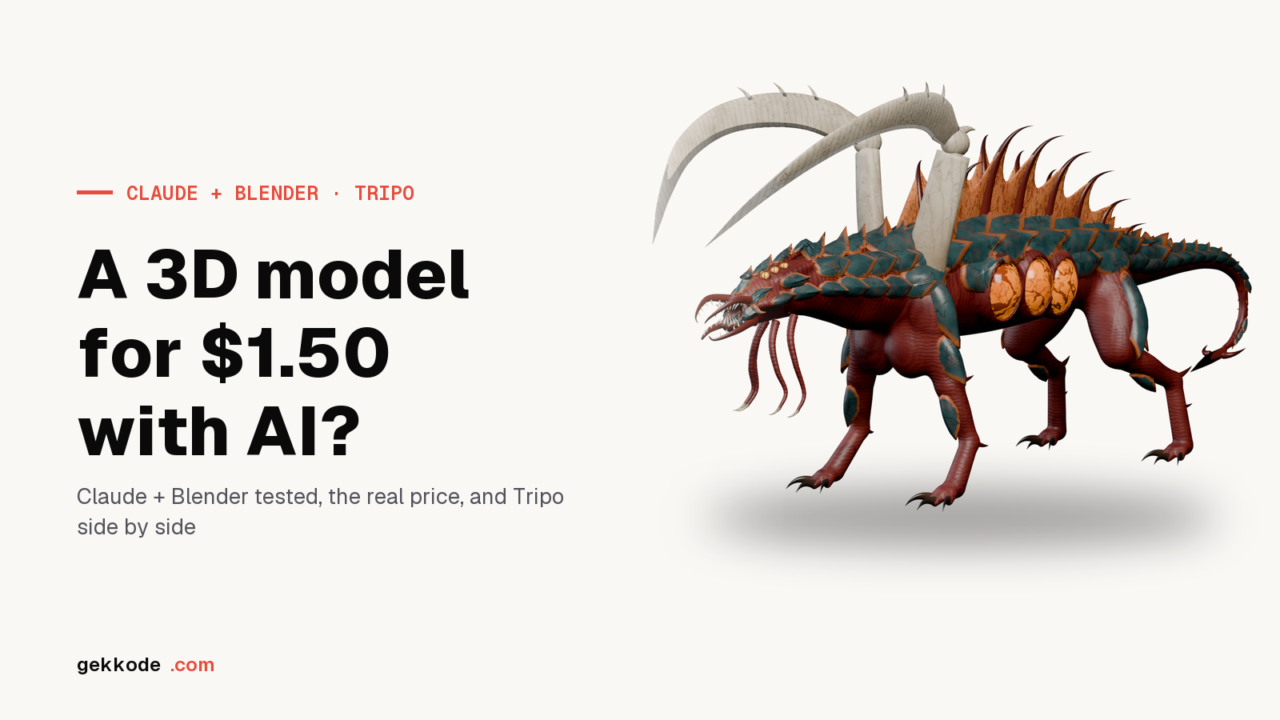
Claude Opus 5.5 builds, on its own in Blender, a complete 3D model for a game in 1 hour 30 minutes: 281 pieces, 95 bones, eight animations and 4K textures. It is not “triple-A”, and the $1.50 price only holds with a $200 a month subscription, because the test costs $22 at API rates. Tripo's model, animated by Claude, gives the best result.
Un modèle 3D de jeu à 1,50 $ avec l'IA ? J'ai testé Claude + Blender
The Gekkode YouTube channel publishes more videos about AI and code.
Subscribe to support the channelOn 2 November 2026, a developer posted a 3D model of a video game creature on X, built entirely by Claude Opus 5.5 in Blender, the free 3D modelling software, for $1.50. He describes it as “AAA” quality, or “triple-A”, the level of big-budget games.
I repeated the experiment with my own creature. In 1 hour 30 minutes, Claude built everything on its own, from the model to the eight animations, without a single tweak from me. The result is not triple-A, and the $1.50 price only holds with a $200 a month subscription. I then gave the same images to Tripo, a 3D model generator, and made the two work together.
The post that promises a game monster for $1.50
The author, Paruchh, is building an online role-playing game with AI. His post of 2 November shows the Mossback Strider, a beast that carries a garden of moss and ferns on its back. He announces 389 pieces, 73 “bones” (the segments of the virtual skeleton that makes it move), eight animations and 4K textures. These textures are images 4,096 pixels on each side that wrap around the model.
The author details his method in a reply under the post: four concept images generated by AI, a single request to Claude Opus 5.5 set to maximum effort, and Claude checking its own work image by image. He says he never guided it at any point.
The post’s method, followed to the letter
I started from the same ingredients. First, four views of the creature, from the side, the front, the back and the top, generated by GPT Image 2.5 from Codex, in about forty seconds each. I had asked for a zergling, the StarCraft beast. Claude chose to invent an original creature of the same kind, the Reaper, a swarm predator with two big scythes made of bone.
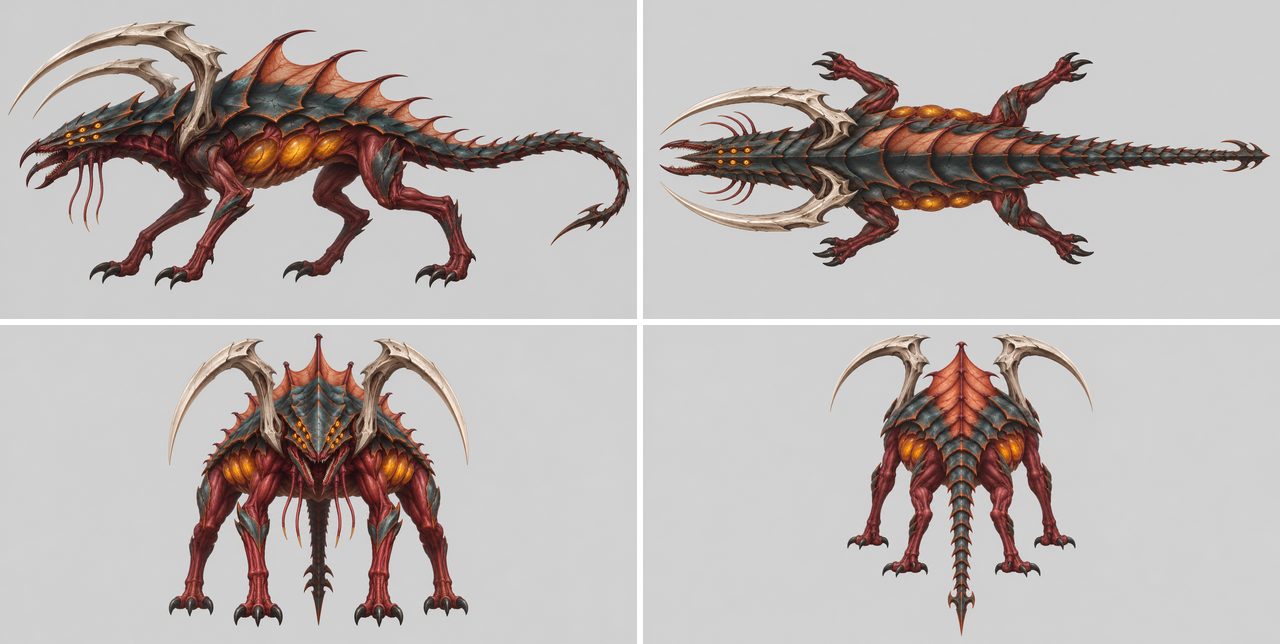
Next, a single request in Claude Code, Claude’s coding assistant, and I don’t touch it again. It comes down to four steps: model the creature, give it a skeleton, paint its textures and animate it. Claude works with Opus 5.5 at the maximum effort level, the model I had already pitted against GPT-6 Sol on a 3D storm.
Claude doesn’t click anywhere in Blender. It writes Python code, the language Blender understands, and Blender runs it in the background, with no window open. I used no plugin at all, not even the Blender connector that Blender’s developers published for Claude. It is called Blender MCP, MCP being the standard that plugs an AI into software. This connector drives a Blender that is already open, with an extension turned on, from the Claude Desktop app. Here, Claude didn’t need it.
Step 1 of 4: Claude models the creature in Blender
Claude sculpts as if it were working with dough, using simple shapes that merge into a single one. It builds the body first, a shell drawn from the side and top silhouettes. Then come the legs, the head, the filaments under the mouth, nearly a hundred shell plates laid one by one on the skin, the sail of spines, the scythes, the glowing sacs and the tail.
The model has 281 pieces. It is finished after 45 minutes, and the skeleton, the textures and the animations take the next 45 minutes.
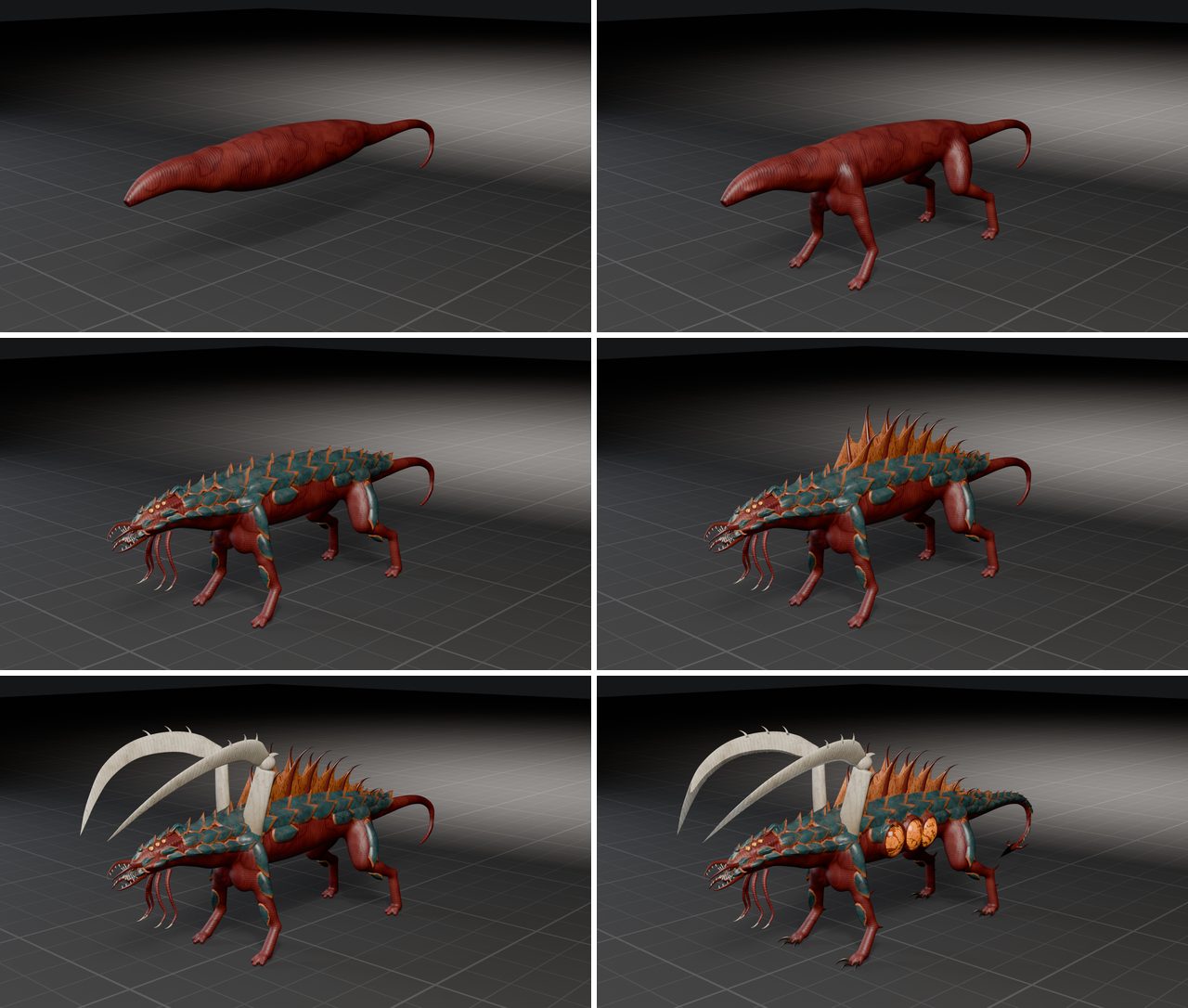
What Claude sees and corrects on its own
After each step, Claude renders a check image and looks at it. At one point, it overlays its model on the concept views and measures how much of the silhouettes overlap. A score of 100% would mean two identical silhouettes, and it gets 48% on the side view. It finds on its own what is wrong, a belly that hangs too low and legs that are too thick, then it corrects them. Once all the pieces are in place, the overlap rises to 61%.
That is not the only mistake it spots. In the first render, its skin was salmon pink, with a turtle-shell pattern. Its glowing sacs stayed trapped under the skin. Its plates were too small and showed up as blotches, and its eyes looked like buttons. Five times, it rebuilt everything after looking at its images.
What struck me most is that it sees its own mistakes and corrects them without anyone telling it anything.
Steps 2 to 4: the skeleton, the game file and eight animations
Step two is Blender rigging: the skeleton, which Blender and the rest of 3D call a “rig”. Claude places 95 bones, 78 of which deform the skin, and attaches each of the 281 pieces to those bones. It sets up the legs so that you place a foot and the whole leg bends on its own, like a puppet whose arm follows when you move its hand. It even works out, for each knee, the angle that makes it bend the right way.
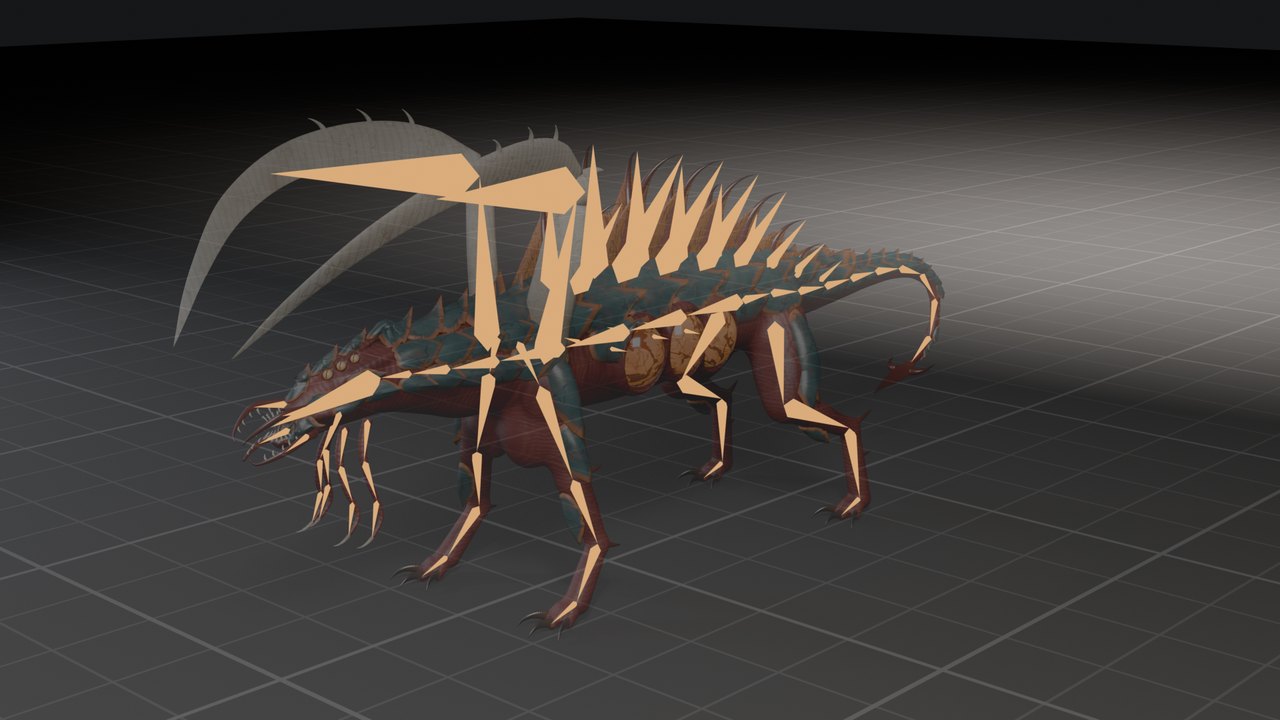
Step three is to make it a game object. Claude merges the 281 pieces into a single mesh of 123,726 triangles, the small facets that make up the surface. It then paints four 4K textures, one for colour, one for roughness, one for relief and one for light. To compute them, it copies the details of a very fine model into the textures of a lighter model, which artists call baking.
Here, Blender crashes during the calculation on the graphics card. Claude switches to the processor and runs it again. It then sees that the texture fills only 40% of the image, tightens it and starts over. It ends up with a 66 MB GLB file, a format that game engines such as Godot import directly. I reloaded it in a clean Blender: the 78 bones, the eight animations and the four textures are all there.
Step four is the animations. Claude writes eight of them, in code, frame by frame, with no motion capture: rest, walk, run, attack, leap, alert, being hit and death. The leap moves forward one metre, the alert ends with a nervous step back and the death animation lays the creature on its side.
Here again, it checks itself. For every frame of every animation, it measures the lowest point of the creature. Out of 397 frames, 141 dip below the floor by more than a centimetre, up to 17 centimetres during the death animation. It finds two causes: feet that pivot around the wrong point and a body lying down that is not repositioned on the floor. It writes a fix and checks again. In the end, not a single frame goes below the floor any more. It also spots, by eye, scythes sticking up like antennae during the run, and folds them forward.
Verdict: is it triple-A?
No. The model looks like the concept image without being 100% faithful to it. Look at the legs, much too close to the body. It’s good, but not incredible.
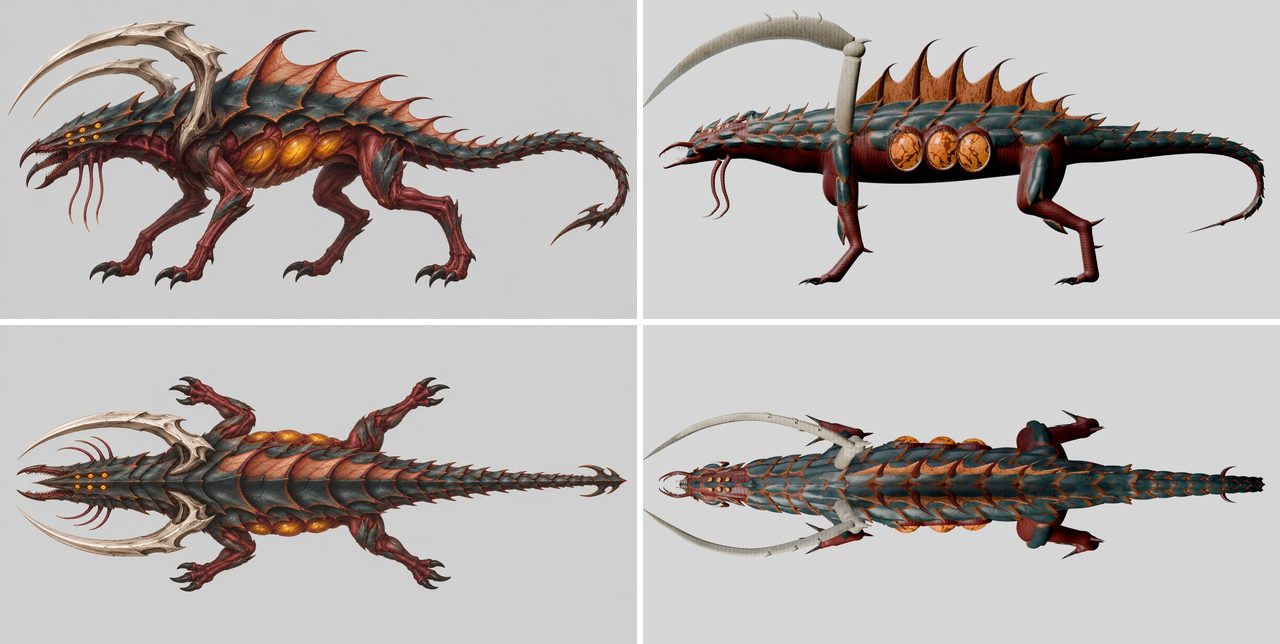
On paper, the numbers are similar. Paruchh announces 389 pieces and 73 bones, my Reaper has 281 pieces and 95 bones, with eight animations on each side. What is missing is finesse.
Under his post, other developers find his own creature stylised, not at triple-A level. One of them, who had tried the same thing, says the shape came out right but lost all its charm. Paruchh is on his nineteenth creature, with well-honed settings, and I was starting from zero with a single attempt.
Try it at home
Blender is free. You need Claude Code, a Claude subscription and four images of your creature, then about an hour and a half. The advice I take from the test: demand a check image after each step, and ask Claude to look at it.
The real price: $22, not $1.50
At public API rates, the plan where you pay for each use, the test cost $22.35. An AI bills in tokens, small chunks of words. At each step, Claude re-reads the whole conversation from the start, and the longer it gets, the more each step costs. A re-read token costs a hundred times less than a written one, but Claude re-read 155 times more of them.
| Item | Quantity | Rate per million tokens | Cost |
|---|---|---|---|
| Tokens re-read | 53.1 million | $0.20 | $10.62 |
| Tokens written | 342,000 | $20 | $6.84 |
| Tokens kept in memory to be re-read | 611,000 | $8 | $4.89 |
The total comes to $22.35. With my Ultra subscription, the test used 3% of the weekly quota. The subscription costs $200 a month, or about $46 a week, and 3% of that amount is roughly $1.40. So it comes close to the $1.50 announced, provided you pay for the subscription. To lighten this bill, I tested hooks and skills in my article on the price of Claude Code.
My review of Tripo AI: the same monster for $0.95
Tripo, also called Tripo AI or Tripo 3D, is an AI 3D model generator that turns images into a 3D model, what people search as “image to 3D”. I gave it the same views as Claude: the front, the back, the left side, and the right side obtained by flipping the left one, because Tripo doesn’t accept a top view.
After six minutes of computing, I had the model, its skeleton and a walk animation, for $0.95. Tripo 3D’s pricing is pay-as-you-go, with no subscription, at $0.01 per credit: 60 credits for the high-definition model, 25 for the skeleton and 10 for the walk.
The crest, the scythes and the skin are far more detailed than on Claude’s model. But Tripo’s model has six legs instead of four. The concept views show a beast mid-stride, with its legs staggered, and Tripo made three pairs out of that.
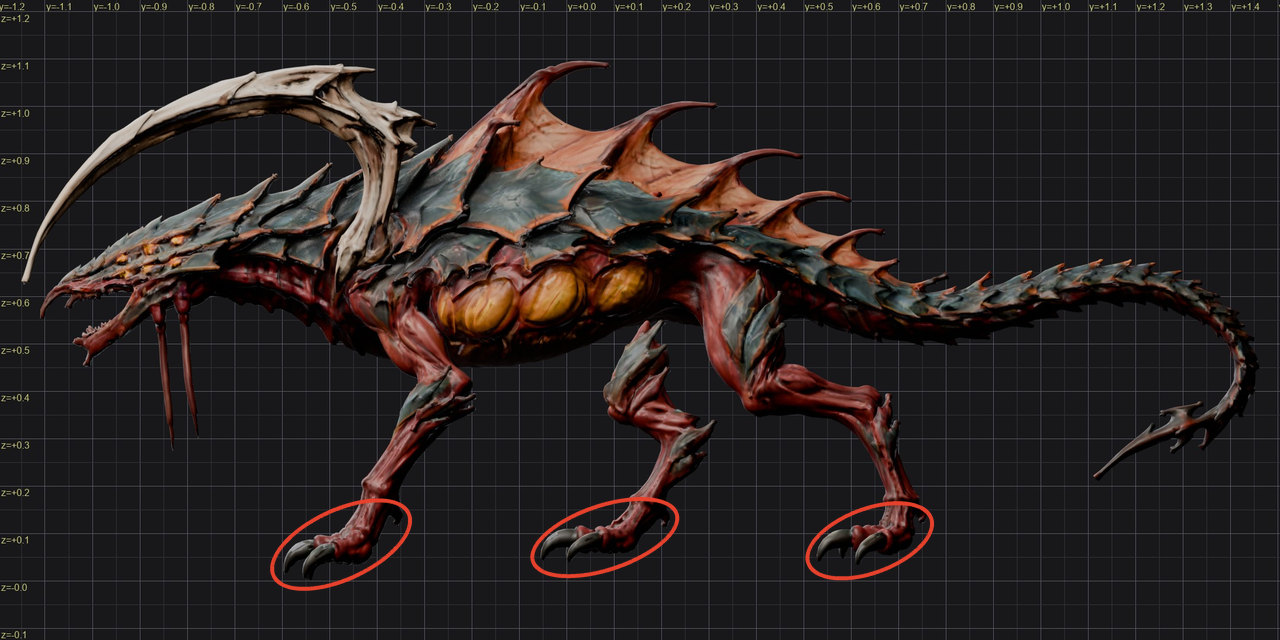
Its automatic skeleton, though, handles only four. In the walk it delivers, four legs out of six barely touch the floor and the back feet sink into it. It is also the only animation Tripo accepts for a quadruped: the run, the attack, the jump and the others are refused.
The file is heavy: a single block of 1.9 million triangles, fifteen times more than Claude’s. So my verdict on Tripo AI is mixed. For $0.95 and six minutes, the result is impressive in detail, but you have to count the legs before celebrating, and only the walk is animated.
Tripo + Claude: the best result
I then took Tripo’s model and let Claude do the rest, in Blender, with a single request. Claude is the one that spotted the six legs. It builds its own skeleton of 101 bones, 71 of which deform the skin, with six legs of four bones each. It lightens the model from 1.9 million to 153,555 triangles, without touching the textures and with no visible difference on screen, then it makes the eight animations.
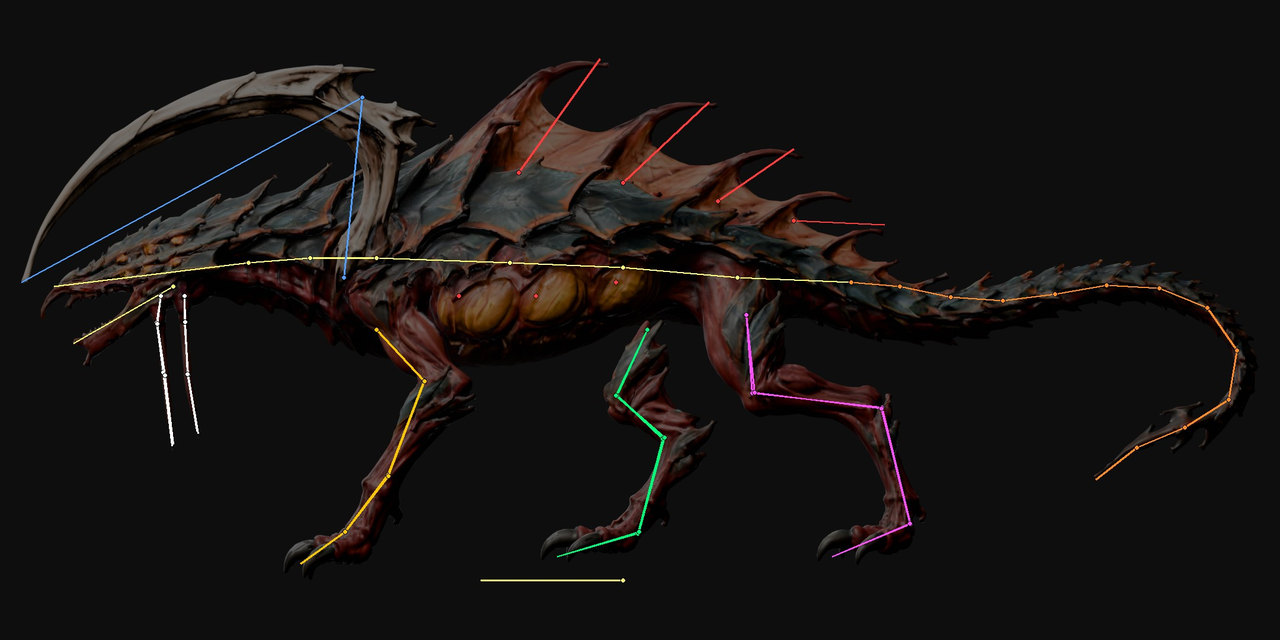
It corrects itself here too, on its own check images. It sees the head stuck in the ground during the leap, the body sunk 32 centimetres into the floor during the death animation and the scythes sticking up during the run. It fixes them, redoes the image and checks.
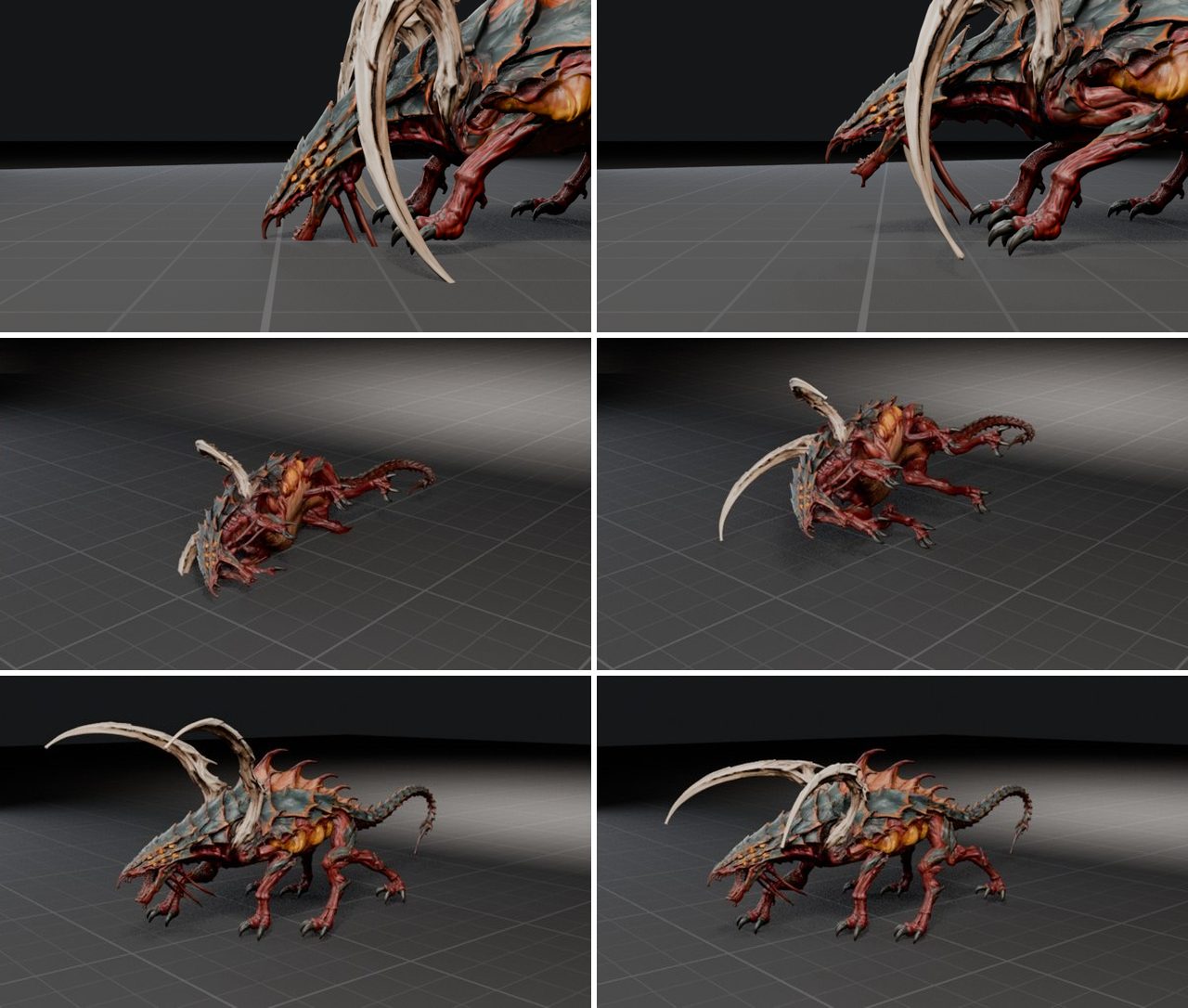
The result: six legs that finally touch the floor and eight usable animations. Not everything is perfect. The skin still stretches at the hips when the legs move a lot. This test took 1 hour 8 minutes and cost $32.46 at API rates, or about $2 of my subscription (estimated proportionally from the previous test), plus $0.60 for Tripo’s model.
| Claude alone | Tripo alone | Tripo + Claude | |
|---|---|---|---|
| Duration | 1 hour 30 minutes | 6 minutes of computing | 1 hour 8 minutes |
| Cost at API rates | $22.35 | $0.95 | $33 ($32.46 and $0.60) |
| Cost with the Ultra subscription | about $1.40 | $0.95 | about $2.60 |
| Triangles | 123,726 | 1,919,461 | 153,555 |
| Skeleton | 95 bones, four legs | 52 bones, four legs | 101 bones, six legs |
| Animations | 8 | 1, the walk | 8 |
| Fidelity to the concept | similar, legs too close to the body | more detailed, six legs | more detailed, six legs that walk |
For a prototype, an indie game or a base to touch up, this is already very useful. For triple-A, you still need an artist behind it. On the code side, I had Codex write a strategy game prototype in under two hours.
What to remember
- Claude Opus 5.5 builds a complete game creature in Blender on its own in 1 hour 30 minutes: 281 pieces, 95 bones, eight animations and 4K textures.
- It is not triple-A. The model looks like the concept without being 100% faithful to it, with legs too close to the body.
- The $1.50 price only holds with a $200 a month subscription. At API rates, the test costs $22.
- Tripo AI turns out a more detailed model in six minutes, for $0.95, but with six legs and a single animation.
- Tripo’s model animated by Claude gives the best result: eight usable animations for $33 at API rates.
- For a similar test, demand a check image after each step and ask Claude to look at it.