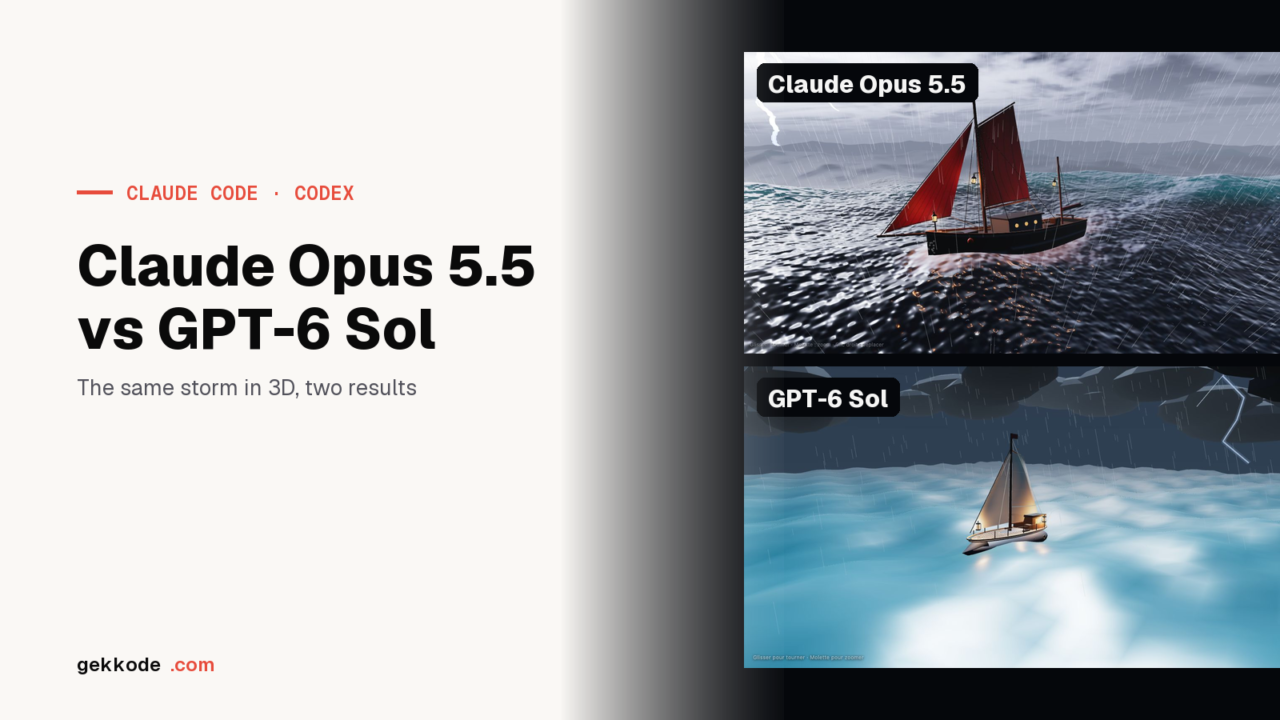
For the same 3D brief, a fishing boat in a night storm, Claude Opus 5.5 in Claude Code delivers the most faithful scene, but takes almost 39 minutes and costs about $6.96 at API rates. GPT-6 Sol in Codex also meets all thirteen points of the brief in 5 minutes for about $0.29, with a clearer, less stormy scene. Both scenes run inside the article.
On 22 September 2026, Anthropic released Claude Opus 5.5 and OpenAI released GPT-6 Sol, on the same day. That same evening, I gave both the brief from our first duel, a fishing boat caught in a night storm, in 3D, on a single web page.
Each model works inside its maker’s coding assistant, Claude Code for Opus 5.5 and Codex for GPT-6 Sol. These assistants do more than reply in a chat window. They write files on the computer, run commands and check back over their own work. Both finished scenes run below, right in your browser. Click “Run all”, or open the full-screen view to see them side by side.
Même consigne qu'au premier duel du 7 septembre : un voilier de pêche dans une tempête de nuit, en 3D, dans une seule page web. Un seul passage, aucune retouche, et les deux scènes livrées s'exécutent ici, dans une sandbox, sur votre machine.
Shared prompt
Crée une scène 3D en three.js, dans un seul fichier index.html autonome, sans build ni dépendance locale (three.js chargé depuis un CDN par import map en module ES, version r170 ou plus récente).

Sujet : un voilier de pêche navigue de nuit sur une mer agitée, en pleine tempête.
- Mer : surface animée avec des vagues (déplacement de vertex), reflets sombres, écume discrète sur les crêtes si possible.
- Ciel : nuit noire, nuages bas, pluie visible (particules) poussée par le vent.
- Éclairs : toutes les quelques secondes, un éclair illumine brièvement toute la scène (flash, fort contraste, silhouette des nuages), avec un délai aléatoire entre deux éclairs.
- Bateau : coque, pont, mât, gréement et voile, modélisés uniquement avec des primitives three.js (aucun modèle externe, aucune texture externe). Il tangue et roule en suivant les vagues.
- Lanternes : au moins trois lanternes accrochées au bateau, lumière chaude et vacillante, qui éclairent le pont et l'eau autour du bateau.
- Caméra : contrôles orbitaux (OrbitControls) avec une position de départ qui met le bateau en valeur.
- Performance : viser 60 images par seconde sur un ordinateur portable ; le redimensionnement de la fenêtre est géré.
- Interface : aucune, à part un petit texte discret en bas à gauche indiquant les commandes.

Contraintes : tout le code (HTML, CSS, JavaScript) dans index.html ; pas de fichiers supplémentaires ; le fichier doit fonctionner en l'ouvrant directement dans un navigateur moderne (Chrome, Firefox, Safari). Ne pose pas de question, livre le fichier complet.
Protocol
La même consigne, en français, que lors du premier duel du 7 septembre 2026, envoyée telle quelle aux deux IA le 22 septembre 2026, jour de leur sortie, sans échange ensuite ni retouche du résultat. Claude Code avec le modèle Claude Opus 5.5 et Codex avec le modèle GPT-6 Sol, tous deux réglés sur le niveau de réflexion « xhigh », comme au premier duel. Chaque IA a travaillé seule, dans un dossier vide, avec ses réglages d'origine et dans sa sandbox : elle pouvait écrire dans son dossier et chercher sur le web, mais ni sortir de ce dossier ni ouvrir un navigateur. Aucune des deux n'a donc vu sa scène avant de la rendre. Mesures : temps de travail, coût au tarif public de l'API, respect point par point de la consigne, erreurs au chargement, rendu dans Chrome en 1 280 × 720, fluidité sans carte graphique puis sur une carte graphique récente, sans limite d'images par seconde, et fluidité sur votre machine dans ce banc.
Runs in an isolated sandbox (iframe sandbox and CSP): no access to the site, cookies or your session. Nothing loads before you click.
Runs in an isolated sandbox (iframe sandbox and CSP): no access to the site, cookies or your session. Nothing loads before you click.
| Measurements | A · Claude Code · Claude Opus 5.5 | B · Codex · GPT-6 Sol |
|---|---|---|
| Temps de travail | 38 min 39 s | 5 min 03 s |
| Coût au tarif public de l'API | ≈ 6,96 $ | ≈ 0,29 $ |
| Points de la consigne respectés | 13 sur 13 | 13 sur 13 |
| Erreurs au chargement | 0 | 0 |
| Poids de la page | 42 Ko | 20 Ko |
| Bateau | bateau de pêche à deux mâts, voiles tannées | voilier de plaisance à un mât |
| Lanternes | 4, dont 3 qui se balancent | 3 |
| Images par seconde sans carte graphique (rendu logiciel, sans limite) | 16 | 36 |
| Images par seconde sur carte graphique récente (Apple M5 Pro, sans limite) | 753 | 327 |
Verdict
Claude Opus 5.5 livre la tempête la plus fidèle : un bateau de pêche à deux mâts et voiles tannées, une mer noire qui se creuse en houle, des embruns à l'avant, quatre lanternes dont trois se balancent, et des éclairs qui découpent la silhouette des nuages. Il lui a fallu près de 39 minutes et environ 6,96 $ au tarif de l'API. GPT-6 Sol remplit aussi les treize points de la consigne, en 5 minutes et pour environ 0,29 $, avec une scène plus claire et plus calme : un voilier de plaisance, des nuages en facettes et une mer qui blanchit d'un coup sous l'éclair. La meilleure scène d'un côté, près de huit fois plus vite et vingt-quatre fois moins cher de l'autre.
Two models released on the same day
Anthropic presents Claude Opus 5.5 as a model on par with Claude Fable 5.1 on most tasks, 40% cheaper to run than Opus 5. Its announcement on 22 September even cites a tester who had several Claude models build a game from a single brief: Opus 5.5 scored best for its graphics and polish.
At OpenAI, GPT-6 Sol carries the advances of GPT-6 Astra into a faster, cheaper model. The announcement published on 22 September on OpenAI’s developer forum makes it available in Codex for Plus, Pro, Business, Enterprise and Edu subscriptions, with API prices cut in half compared with GPT-5.6’s promotional rates. 9to5Mac describes it as the model for complex coding tasks, alongside GPT-6 Luna, built for narrower tasks repeated at high volume.
The brief, word for word from the first duel
The request fits on one page. It calls for a scene built with three.js, a free library for drawing 3D in a web page, delivered as a single file that opens in any browser. The subject: a fishing boat sailing by night on a rough sea, in the middle of a storm.
Thirteen requirements follow. A sea that moves, foam on the wave crests, a pitch-black night, low clouds, wind-driven rain and lightning at irregular intervals. A boat built only from basic shapes (cubes, cylinders, spheres), pitching and rolling with the waves, and at least three lanterns with a flickering light. Finally, a camera that turns with the mouse, a window that can be resized, a short help text and a single file. The full brief can be read in the bench, under “Shared prompt”.
Same setting, same sandbox, a single attempt
On 7 September, our first Claude Code and Codex comparison pitted Claude Fable 5.1 against GPT-6 Astra on exactly the same brief. I kept the same rules: a single attempt, no touch-ups, and the same thinking level on both sides, “xhigh”.
This setting fixes how long the AI can spend thinking before and during its work, like the preparation time given to a candidate before an oral exam. “xhigh” is the notch just below the maximum. Each maker grades its own scale, so the same word does not guarantee the same amount of thinking at Anthropic and at OpenAI.
Each AI worked alone, in an empty folder, with its default settings and inside its sandbox, a closed room where it can write to its own folder and search the web without touching the rest of the computer. Our article on the Claude Code and Codex sandbox details what it blocks. Here, it ruled out opening a browser: neither AI could look at its scene before handing it in.
Claude Opus 5.5 built a real fishing boat
Opus 5.5 delivered a two-masted fishing boat, with brick-red tanned sails like those of old working boats. The dark hull carries a pale waterline. On deck sit a cabin with lit portholes, a lifebuoy, nets, orange buoys, crates and coiled ropes. The deck planks and the sailcloth are painted by the code itself, with no image loaded from outside.
The sea is a deep swell that dips low enough to hide the hull at times. It streams past beneath the boat, which appears to move forward, with foam on the crests, against the hull and in the wake. Sea spray flies up when the bow plunges into a wave. Four lanterns light the deck, and three of them, hanging, swing with the roll.
Between lightning flashes, the night is truly black. You can make out the boat by its lanterns, its portholes and their reflections shimmering on the water, under a dense rain of 16,000 streaks that turn orange near the lanterns. Each lightning strike arrives as two to four flashes in quick succession. It lights up the sky behind the clouds, picks out their outline, reveals the height of the waves in an instant, and one time in five it stays hidden inside the clouds.
GPT-6 Sol, a brighter, calmer scene
GPT-6 Sol built a single-masted sailing boat, with a pale hull and a wooden deck, a small cabin with lit windows, barrels, crates and a red flag snapping in the wind. Three lanterns light the deck and cast patches of warm light on the water. Two pale streaks mark its wake.
The sky is black, but the sea, a luminous blue-green, throws back a lot of light, and the waves stay small. The scene reads clearly from the first second, feeling more like a trip out to sea on a rainy evening than a storm. The low clouds are built from large, faceted blocks. When lightning strikes, a jagged streak of light appears on the horizon and the whole sea turns white in an instant.
Both files tick all thirteen points of the brief, with not a single error on loading. The difference comes down to interpretation: Opus 5.5 took “fishing boat” and “storm” literally, GPT-6 Sol delivered a calmer, easier scene to look at.
Thirty-nine minutes versus five
GPT-6 Sol handed in its file after 5 minutes. Opus 5.5 thought for almost half an hour before writing the first line, then built its page piece by piece and reviewed and corrected it over about ten minutes, for 38 minutes and 39 seconds in total.
At the public API rate, the one paid by developers who plug a model into their own programs, Opus 5.5’s run would cost about $6.96, and GPT-6 Sol’s about $0.29. Both were paid for by a subscription, Claude on one side and ChatGPT on the other, which counts these runs against a quota rather than in dollars.
The gap does not come from the listed price. Anthropic charges two and a half times less for Opus 5.5 than for Fable 5.1, but on this brief it produced almost five times more text than Fable 5.1 did in the first duel, and almost sixteen times more than GPT-6 Sol. Most of that text is a thinking draft nobody reads, but it still gets billed. On 7 September, Fable 5.1 had taken 20 and a half minutes and GPT-6 Astra 13 and a half minutes, for about $4.70 and $2.20. GPT-6 Sol therefore does the same work nearly three times faster and nearly eight times cheaper than its predecessor, while Opus 5.5 cost more than Fable 5.1 on this storm.
Smooth on a recent Mac, slower without a graphics card
On a computer with no graphics card, the processor draws everything, like a single painter alone in front of a canvas. Under these conditions, GPT-6 Sol’s scene displays 36 frames per second, Opus 5.5’s just 16 (a cinema film runs at 24). A recent graphics card is more like a workshop of thousands of little hands painting at once, and there the order flips: 753 frames per second for Opus 5.5 against 327 for GPT-6 Sol, measured with no cap on a Mac fitted with an M5 Pro chip.
Opus 5.5 hands almost all the work to the graphics card, right down to the raindrops. GPT-6 Sol recalculates the sea and the rain on the processor for every frame. On a recent computer, both scenes comfortably clear the 60 frames per second the brief asked for, and the bench measures smoothness on your own machine.
Which one to choose?
- For a scene that sticks to the brief and makes an impact straight away, Claude Opus 5.5, allowing for around forty minutes and a few dollars per attempt.
- For quick, frequent attempts, GPT-6 Sol: five minutes and a few cents per attempt, even if you then need to ask it for a darker sea and a proper fishing boat. On longer projects, guided message by message, Codex has already built a game prototype inspired by Dune 2000.
- To run your own comparison, keep in mind that each attempt rolls the dice on some of the AI’s choices. Run again tomorrow, the same brief would produce two different scenes. The bench keeps the brief and both files online, so you can download and replay them.
What to remember
- Same brief, same setting, a single attempt: Claude Opus 5.5 and GPT-6 Sol each tick all thirteen requirements, with no error on loading.
- Claude Opus 5.5 delivers the most faithful storm, with a real fishing boat, sea spray and lightning that picks out the clouds, in almost 39 minutes and for about $6.96 at API rates.
- GPT-6 Sol renders a brighter, calmer scene in 5 minutes, for about $0.29.
- Without a graphics card, GPT-6 Sol’s scene is the smoothest. On a recent graphics card, it’s Opus 5.5’s.
- Neither AI saw its scene before handing it in, and this verdict rests on a single attempt from each, on 22 September 2026.