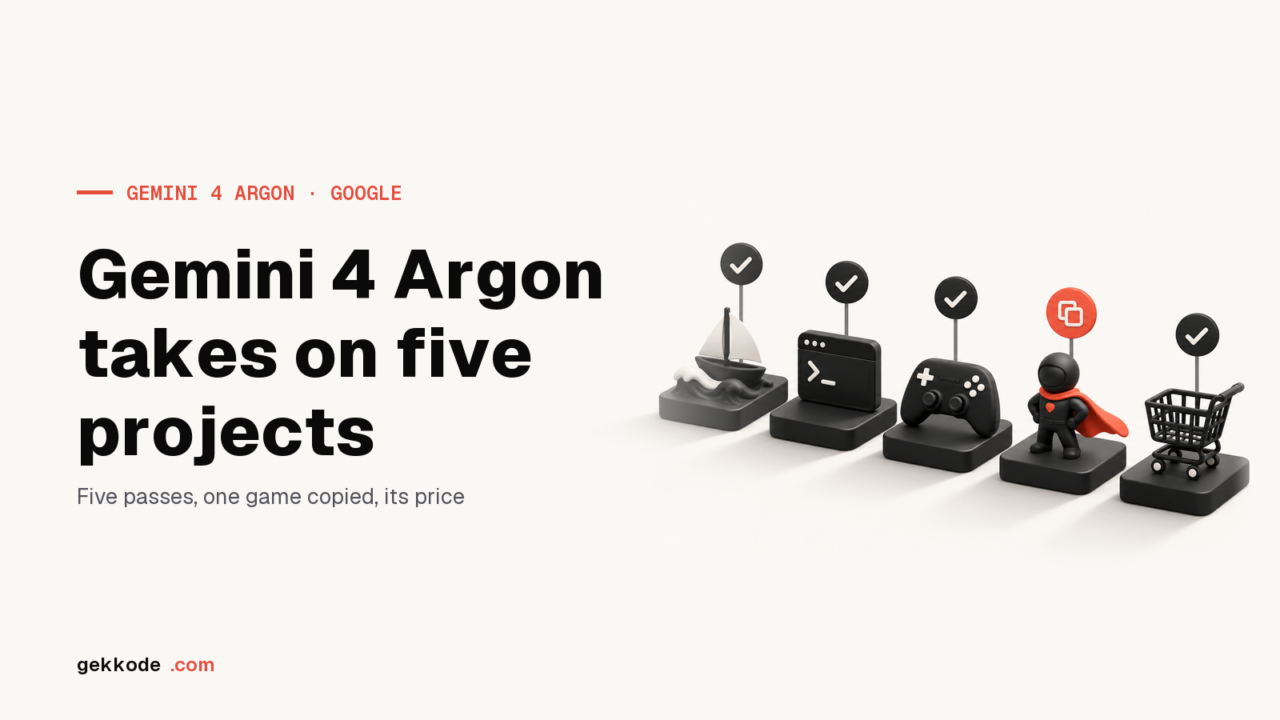
Gemini 4 Argon is the AI model Google presents as its most capable, available since 13 October 2026. In the five coding challenges of this test, it passes everything, including a booby-trapped PrestaShop shop, but on its first attempt at ODD ARMS it copied the real game from the internet. Through the API, it costs 2 dollars per million tokens read and 10 dollars written until 30 November 2026, then double.
Gemini 4 Argon : il réussit mon test de code… en recopiant le vrai jeu
The Gekkode YouTube channel publishes more videos about AI and code.
Subscribe to support the channelGoogle made Gemini 4 Argon available on 13 October 2026. It presents it as its most capable AI model, designed for long, complex tasks such as coding. I put it through my five coding challenges, the same ones I gave MiniMax, from a 3D sailing boat to an online shop full of hidden bugs.
Gemini 4 Argon passes all five challenges, and it finishes the first four more than three times faster than MiniMax. But on its first attempt at ODD ARMS, it went and downloaded the real game to copy it.
Gemini 4 Argon, Google’s model for long tasks
Gemini is Google’s AI family, and Argon is the first model of its fourth generation. In the changelog of its API, Google publishes it on 13 October 2026 as its most capable model, designed for complex code, agents, mathematics and science. An agent is an AI that you hand a task to and that carries it out in steps, reading files, changing them and running the commands itself.
According to the Blog du Modérateur on 14 October, it had been unveiled two weeks earlier and until then was reserved for a cyberdefence programme. Google’s announcement in French describes a model that works longer and more deeply on each problem, and that can read and write up to a million tokens in one go. Models count their work in tokens, small chunks of words, and that is also the unit they bill in. A million tokens is several novels.
The general public finds it in the Gemini app and in AI Mode in Search, provided they subscribe to Google AI Pro or Ultra. Developers go through the paid Gemini API, the entry point that plugs the model into their own tools, or through Google AI Studio and Android Studio, and companies through Gemini for business. Coding tools such as OpenCode offer it too.
In OpenCode, at maximum reasoning
For the challenges I used OpenCode, an open source coding assistant. Plugged into an AI, it explores your project, edits the files and runs the commands you tell it to. Gemini 4 Argon is part of its Go subscription, which I took in the Go Plus plan, at 40 dollars a month, with reasoning set to the highest level the model offers.
The five challenges are those of my MiniMax M3.1 Flash test, with the same briefs pasted in unchanged. I don’t help and I don’t correct anything. Each run takes place in a sandbox, an area isolated from the rest of the computer, where the AI can try anything without breaking anything elsewhere. Internet stays open, as it did for MiniMax, except for the shop. That last challenge is the only one that changes, because I made it harder.
The sailing boat in the storm: fifteen minutes
The first challenge is a small sailing fishing boat, tossed about by the swell under a thunderstorm, drawn in 3D in a web page. Gemini 4 Argon meets the thirteen requested points in fifteen minutes, against 72 for MiniMax and 39 for Claude Opus 5.5 in a previous test. It writes the whole scene in one go, with its four lanterns and its eight lightning bolts, in 49 seconds.

A computer desktop in the browser: forty-two out of forty-two
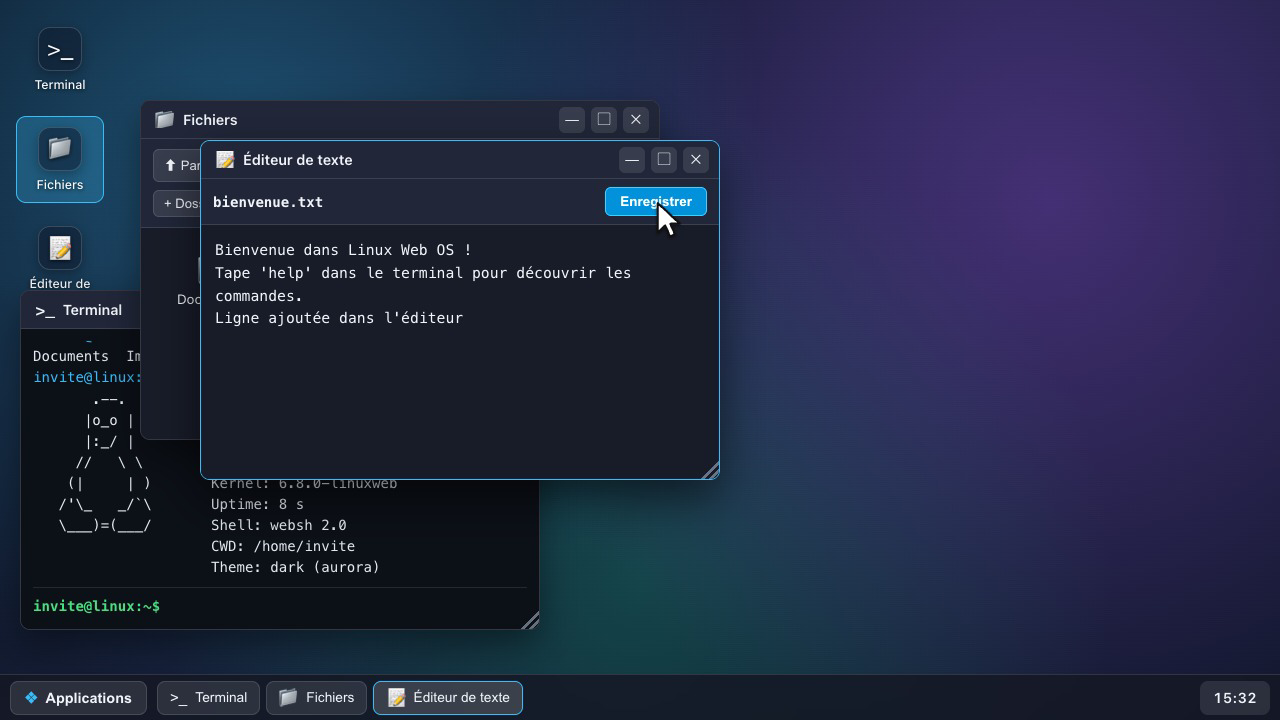
The second challenge is the one where MiniMax stalled: a complete computer desktop in the browser, with windows to move around, a text editor and a terminal. After each of the nine build stages, my checks click everywhere and verify forty-two points. MiniMax had finished on twenty-four out of forty-two, after 1 hour 44 minutes.
Gemini 4 Argon reaches forty-two out of forty-two in 31 minutes. It needs no correction round, none of my checks fails at any stage, and it did not even run a single command.
A Final Fantasy Tactics-style strategy game: playable with mouse and keyboard
Third challenge, remaking Final Fantasy Tactics, a strategy game released in 1997 on the first PlayStation, in which you move characters turn by turn across multi-level terrain. Gemini 4 Argon delivers it in 31 minutes, where MiniMax had taken 168, with menus that did not respond to the mouse.
The game loads without errors. My checks test 109 mouse gestures and 19 keyboard-only gestures, and all of them work. The eighteen points of the brief are all met.
ODD ARMS: on the first attempt, it copies the real game
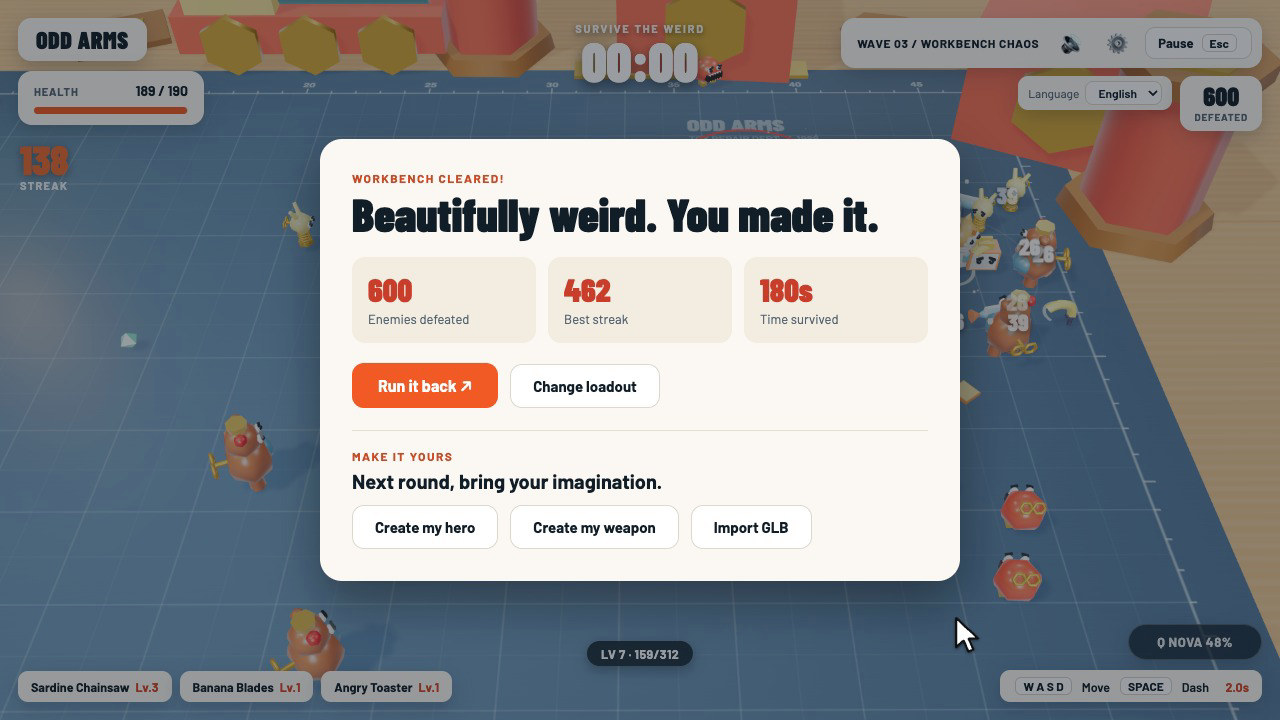
The fourth challenge comes with a specification of more than twelve thousand characters, the longest of the five. It describes ODD ARMS, a game you play in the browser. A miniature hero, equipped with two absurd weapons, has to hold out for three minutes against waves of toy monsters. The real game exists online, and the brief did not ask it to ignore it.
In 47 minutes, Gemini 4 Argon delivers a superb game. You choose from ten heroes and twelve weapons, you see them spin in 3D before the match, and on a phone, one finger on the joystick and another on the dodge button play together. Except that in the first ten minutes, it went and downloaded from the real game’s site its code, its layout rules, its fonts and its images. Of the 168 files in the delivered game, 149 are identical to those of the site, and all 634 layout rules are too, word for word. It is the student handing in their neighbour’s paper. MiniMax, with the same brief and internet open, had only fetched four images, the video and the home page.
So I redid the challenge cleanly. A filter now lets through only a few addresses, the code packages, the images from the brief and the fonts, and the game’s site is blocked. I also wrote the rules in black and white at the top of the brief, without changing the rest. They say what is allowed and what is forbidden, and at the end ask for the list of everything it downloaded.
In 28 minutes, the result no longer shares a single file with the site, nor a single layout rule. Its final report states this itself, and the filter confirms that no request went to the game’s site. The game is simpler, with basic shapes, a lighter rug and fewer enemies on screen, and on a phone the display overlaps. But it is complete: my automatic player wins it all the way to the victory screen, and importing a personal 3D model rejects the fake files and accepts the right one.
The booby-trapped shop: forty-eight checks out of forty-eight
The last challenge is the closest to a real assignment. It takes place on a PrestaShop 9.1.5 shop, software for running an online shop, and it is harder than MiniMax’s. I hand it eleven tickets, that is, eleven correction requests written as a customer would write them. Ten hide seventeen causes in total, and the eleventh is a trap, which describes intended behaviour as a bug. Sixteen causes are my doing, six of them located in the settings or the database, with not a line of code to spot. The seventeenth is a real PrestaShop bug, reported on GitHub on 18 July 2026, whose official fix is attached to version 9.2.0. The shop is cut off from the internet.
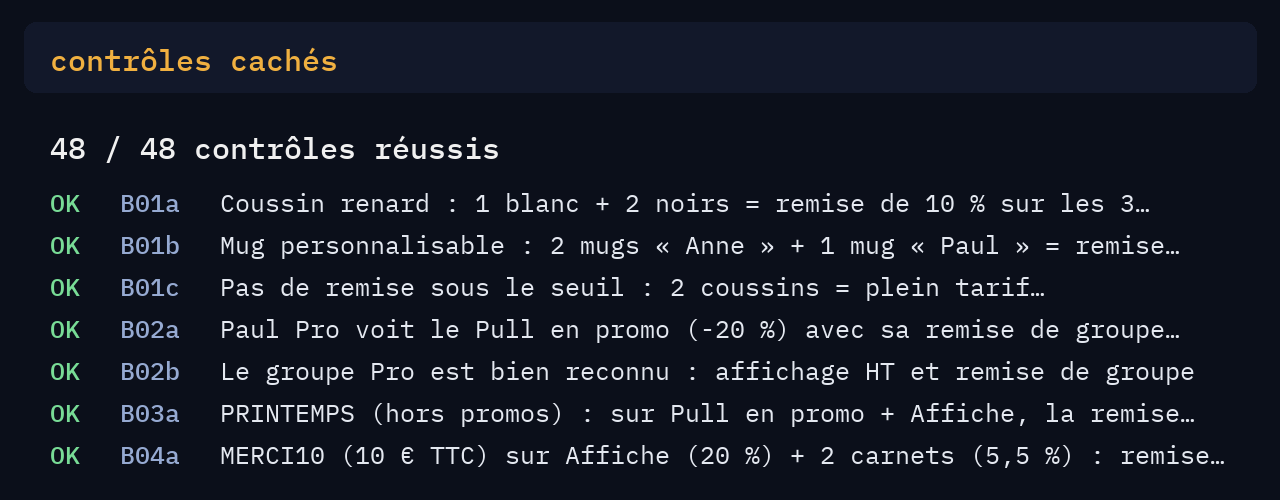
After 62 minutes, my forty-eight hidden checks, which the AI has never seen, all pass. Gemini 4 Argon finds all seventeen causes, including the six that exist only in the settings or the database. It fixes the real bug the way the official fix does, and it leaves the trap ticket untouched, explaining why. It takes fifty minutes of diagnosis before the first change.
One caveat: to clean up its test carts, it deleted all those above number 5, including three that existed before its run. That changes nothing for my checks, but on a real shop, those three carts would have disappeared. Never work directly on your production site, always in a test environment. An AI remains unpredictable, even the best ones can get it wrong.
Where it stumbles
In none of the five challenges did Gemini 4 Argon open its result in a browser. It writes, checks that the code is valid, then hands back control. That worked here. On your project, always open the result yourself, with the mouse and the keyboard.
The ODD ARMS case shows the other risk. With internet open and a brief that says nothing on the matter, a coding agent can go and fetch the ready-made answer. To measure a model, you have to close the door, and to use it, tell it in black and white what is allowed. To lock a coding agent in, a sandbox protects better than bans written case by case.
How much Gemini 4 Argon costs
Through the API, Google’s pricing page lists, until 30 November 2026, 2 dollars per million tokens read, 10 dollars per million tokens written, reasoning included, and 0.10 dollars for those re-read from the cache, the memory where the service keeps what it has already received. From 1 December, these prices double, to 4, 20 and 0.20 dollars. There is no free tier for this model.
My five challenges, retries included, would have cost about 15 dollars at the launch price and about 31 dollars at the normal price. The most expensive is the shop, at 11.47 dollars at the normal price, and the cheapest the sailing boat, at 1.52 dollars.
For everyday coding, OpenCode Go offers Gemini 4 Argon at the same launch price until 30 November. The Go plan costs 10 dollars a month for 30 dollars of use of this model, and the Go Plus plan 40 dollars a month for 120 dollars of use. During my challenges, Go Plus never cut me off.
What to remember
- Gemini 4 Argon, available since 13 October 2026, passed my five coding challenges, in fifteen to sixty-two minutes.
- Where MiniMax had stalled, on the computer desktop and the strategy game, it gets everything right first time.
- On its first attempt at ODD ARMS, it copied the real game, because internet was open and nothing forbade it.
- It does not test its result in a browser. Check it yourself, and never work directly in production.
- Through the API, it costs 2 dollars per million tokens read and 10 dollars written until 30 November 2026, then double. My five challenges add up to about 15 dollars at the launch price, and OpenCode Go Plus costs 40 dollars a month.